
Pythagorean Spiral
Loading the math board and drawing, please wait…
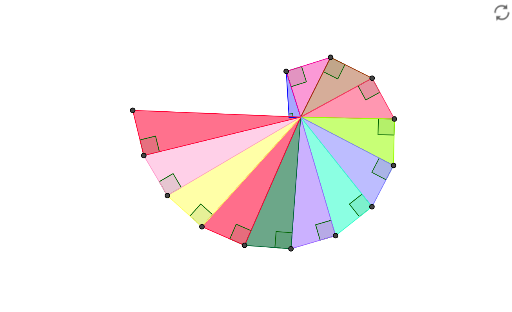
This example demonstrates the application of the Pythagorean theorem in constructing a spiral polygon. It involves core mathematical concepts such as the Pythagorean theorem, right triangles, and polygon construction. The construction uses commands like Circle, Point, Segment, OrthogonalLine, Intersect, Polygon, and Angle in GeoGebra. It is suitable for middle school students and above learning geometric constructions and the Pythagorean theorem.
GeoGebra Commands & Parameters
Circle(A, a) → cPoint(Circle[A, 1]) → CSegment(A, C) → eOrthogonalLine(A, e) → bIntersect(c, b) → B, DPolygon(D, C, A) → poly1, a_1, d, c_1OrthogonalLine(D, a_1) → fCircle(D, a) → gIntersect(g, f) → E, FPolygon(D, F, C) → poly2, c_2, d_1, f_1Circle(F, a) → kOrthogonalLine(F, d_1) → hIntersect(k, h, 2) → GPolygon(G, C, F) → poly3, f_2, g_1, c_3OrthogonalLine(G, f_2) → iCircle(G, a) → pIntersect(p, i, 2) → HPolygon(H, C, G) → poly4, g_2, h_1, c_4OrthogonalLine(H, g_2) → jCircle(H, a) → qIntersect(q, j, 2) → IPolygon(I, C, H) → poly5, h_2, i_1, c_5OrthogonalLine(I, h_2) → lCircle(I, a) → rIntersect(r, l, 2) → JPolygon(I, J, C) → poly6, c_6, i_2, j_1OrthogonalLine(J, i_2) → mCircle(J, a) → sIntersect(s, m, 2) → KPolygon(J, K, C) → poly7, c_7, j_2, k_1OrthogonalLine(K, j_2) → nCircle(K, a) → tIntersect(t, n, 2) → LPolygon(K, L, C) → poly8, c_8, k_2, l_1OrthogonalLine(L, k_2) → b_1Circle(L, a) → e_1Intersect(e_1, b_1, 2) → MPolygon(L, M, C) → poly9, c_9, l_2, m_1OrthogonalLine(M, l_2) → n_1Circle(M, a) → p_1Intersect(p_1, n_1, 2) → NPolygon(M, N, C) → poly10, c_{10}, m_2, n_2OrthogonalLine(N, m_2) → q_1Circle(N, a) → r_1Intersect(r_1, q_1, 2) → OPolygon(N, O, C) → poly11, c_{11}, n_3, oOrthogonalLine(O, n_3) → s_1Circle(O, a) → t_1Intersect(t_1, s_1, 2) → PPolygon(O, P, C) → poly12, c_{12}, o_1, p_2OrthogonalLine(P, o_1) → a_2Circle(P, a) → d_2Intersect(d_2, a_2, 2) → QPolygon(P, Q, C) → poly13, c_{13}, p_3, q_2Angle(C, A, D) → αAngle(C, D, F) → βAngle(C, F, G) → γAngle(C, G, H) → δAngle(C, H, I) → εAngle(C, I, J) → ζAngle(C, J, K) → ηAngle(C, K, L) → θAngle(C, L, M) → ιAngle(C, M, N) → κAngle(C, N, O) → λAngle(C, O, P) → μAngle(C, P, Q) → ν