
Pythagorean Theorem Proof Without Words by Camilo Sua Flórez
Loading the math board and drawing, please wait…
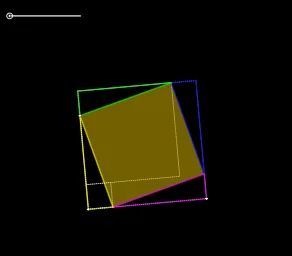
This example demonstrates the Pythagorean Theorem through dynamic geometry, eliminating the need for text. It involves core concepts like area, Pythagorean theorem, squares, linear programming, orthocenter, subtraction, surface area, and isosceles triangles. The construction uses GeoGebra commands such as Polygon, Point, Circle, Intersect, and Rotate. Ideal for high school mathematics teaching or exploration by math enthusiasts for intuitive geometric proofs.
GeoGebra Commands & Parameters
Polygon(A, B, 4) → poly1, f, g, h, i, C, DPoint(i) → ECircle(D, Segment[A, E]) → cCircle(C, Segment[E, A]) → dCircle(B, Segment[E, A]) → eIntersect(c, h, 1) → FIntersect(d, g, 1) → GIntersect(e, f, 1) → HPolygon(F, D, 4) → poly2, j, k, l, m, I, JPolygon(A, H, 4) → poly3, n, p, q, r, K, LPolygon(E, H, A) → t1, a, e_1, h_1Polygon(E, F, D) → t2, d_1, e_2, f_1Polygon(F, G, C) → t3, c_1, f_2, g_1Polygon(G, B, H) → t4, h_2, g_2, bRotate(E, β, F) → E'Rotate(F, β, F) → F'Rotate(D, β, F) → D'Polygon(E', F', D') → t2', d', e', f'Rotate(E, (-β), H) → E'_1Rotate(H, (-β), H) → H'Rotate(A, (-β), H) → A'Polygon(E'_1, H', A') → t1', a', e'_1, h'Polygon(E, F, G, H) → q1, e_3, f_3, g_3, h_3Polygon(I, A', H, A) → q2, i_1, s, h_4, a_1Polygon(I, D', F, D) → q3, i_2, t, f_4, d_2