
3D Optical Illusion Geometric Construction in GeoGebra
Loading the math board and drawing, please wait…
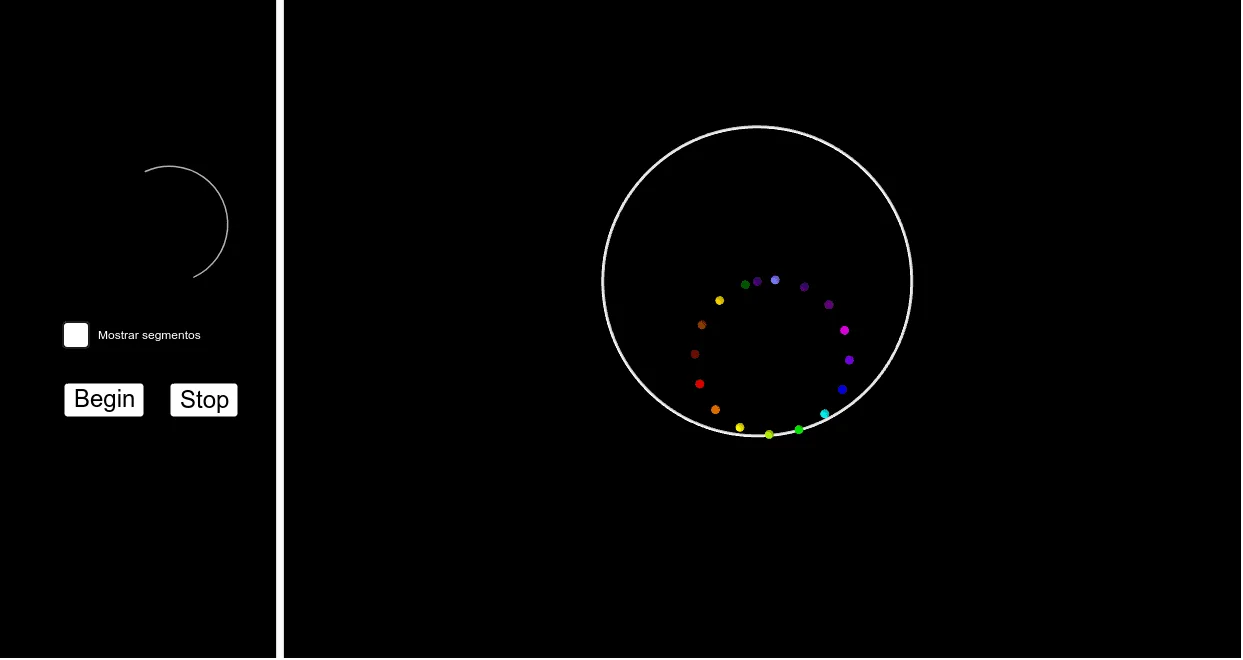
This example demonstrates a 3D optical illusion built from fundamental geometric objects and transformations in GeoGebra. Core mathematical concepts include circle properties, axial symmetry via mirror reflection, orthogonality of points, lines, and planes, angle bisectors, circumcircle arcs, and spatial incidence relationships. The construction employs GeoGebra commands such as Circle, Mirror, Segment, OrthogonalLine, AngularBisector, Intersect, Point, Midpoint, OrthogonalPlane, and CircumcircleArc, together with objects including points A, B, O, P, circles c, lines f through m, and planes n, q, r. It is well suited for high school geometry instruction, classroom demonstrations, and independent study of solid geometry, visual perception, and transformation-based geometric drawing.
GeoGebra Commands & Parameters
Circle(A, B) → cMirror(B, A) → B'Segment(B', B) → fOrthogonalLine(A, f) → gAngularBisector(g, f) → h, iAngularBisector(g, i) → j, kAngularBisector(i, f) → l, mIntersect(c, g, 2) → CIntersect(c, l, 2) → DIntersect(c, h, 2) → EIntersect(c, k, 1) → FIntersect(c, m, 1) → GIntersect(c, i, 1) → HIntersect(c, j, 1) → IIntersect(c, g, 1) → JIntersect(c, l, 1) → KIntersect(c, h, 1) → LIntersect(c, k, 2) → MIntersect(c, i, 2) → OIntersect(c, j, 2) → PIntersect(c, m, 2) → NSegment(C, J) → nSegment(P, I) → qSegment(D, K) → pSegment(L, E) → rSegment(F, M) → sSegment(B', B) → tSegment(G, N) → aSegment(O, H) → bPoint(c) → QMidpoint(A, Q) → RCircle(R, Q) → dIntersect(d, p) → S, TIntersect(d, r) → U, VIntersect(d, s) → W, ZIntersect(d, t) → A_1, B_1Intersect(d, a) → C_1, D_1Intersect(d, b) → E_1, F_1Intersect(d, q) → G_1, H_1Intersect(d, n) → I_1, J_1AngularBisector(p, r) → e, f_1AngularBisector(r, s) → g_1, h_1AngularBisector(s, t) → i_1, j_1AngularBisector(t, a) → k_1, l_1Intersect(c, i_1) → K_1, L_1Intersect(c, k_1) → M_1, N_1Intersect(c, f_1) → O_1, P_1Intersect(c, h_1) → Q_1, R_1Intersect(c, j_1) → S_1, T_1Intersect(c, l_1) → U_1, V_1Intersect(c, e) → W_1, Z_1Intersect(c, g_1) → A_2, B_2Segment(N_1, M_1) → m_1Segment(P_1, O_1) → n_1Segment(Q_1, R_1) → p_1Segment(S_1, T_1) → q_1Segment(U_1, V_1) → r_1Segment(W_1, Z_1) → s_1Segment(A_2, B_2) → t_1Segment(K_1, L_1) → a_1Intersect(d, s_1) → C_2, D_2Intersect(d, r_1) → E_2, F_2Intersect(d, q_1) → G_2, H_2Intersect(d, p_1) → I_2, J_2Intersect(d, n_1) → K_2, L_2Intersect(d, m_1) → M_2, N_2Intersect(d, a_1) → O_2, P_2Intersect(d, t_1) → Q_2, R_2OrthogonalLine(A, xOyPlane) → b_1Point(b_1) → S_2OrthogonalPlane(S_2, b_1) → oOrthogonalLine(B, xOyPlane) → c_1Midpoint(S_2, A) → U_2Mirror(B_2, U_2) → V_2Mirror(P, U_2) → P'Mirror(K_1, U_2) → W_2Mirror(C, U_2) → C'Mirror(N_1, U_2) → Z_2Mirror(D, U_2) → D'Mirror(P_1, U_2) → A_3Mirror(E, U_2) → E'Mirror(Q_1, U_2) → B_3Mirror(F, U_2) → F'Mirror(T_1, U_2) → C_3Mirror(B, U_2) → B'_1Mirror(U_1, U_2) → D_3Mirror(G, U_2) → G'Mirror(Z_1, U_2) → E_3Mirror(H, U_2) → H'Mirror(A_2, U_2) → F_3Segment(B_2, V_2) → e_1Segment(P', P) → f_2Segment(K_1, W_2) → g_2Segment(C', C) → h_2Segment(N_1, Z_2) → i_2Segment(D', D) → j_2Segment(P_1, A_3) → k_2Segment(E', E) → l_2Segment(Q_1, B_3) → m_2Segment(F', F) → n_2Segment(T_1, C_3) → p_2Segment(B'_1, B) → q_2Segment(U_1, D_3) → r_2Segment(G', G) → s_2Segment(Z_1, E_3) → t_2Segment(H', H) → a_2Segment(A_2, F_3) → b_2OrthogonalLine(A_1, xOyPlane) → c_2OrthogonalLine(G_2, xOyPlane) → d_2OrthogonalLine(Z, xOyPlane) → e_2OrthogonalLine(J_2, xOyPlane) → f_3OrthogonalLine(U, xOyPlane) → g_3OrthogonalLine(L_2, xOyPlane) → h_3OrthogonalLine(D_1, xOyPlane) → i_3OrthogonalLine(H_1, xOyPlane) → j_3OrthogonalLine(P_2, xOyPlane) → k_3OrthogonalLine(J_1, xOyPlane) → l_3OrthogonalLine(N_2, xOyPlane) → m_3OrthogonalLine(T, xOyPlane) → n_3OrthogonalLine(F_2, xOyPlane) → p_3OrthogonalLine(C_2, xOyPlane) → q_3OrthogonalLine(E_1, xOyPlane) → r_3OrthogonalLine(R_2, xOyPlane) → s_3OrthogonalLine(O_2, xOyPlane) → t_3OrthogonalLine(I_1, xOyPlane) → a_3OrthogonalLine(G_1, xOyPlane) → b_3OrthogonalLine(M_2, xOyPlane) → c_3OrthogonalLine(S, xOyPlane) → d_3OrthogonalLine(K_2, xOyPlane) → e_3OrthogonalLine(V, xOyPlane) → f_4OrthogonalLine(I_2, xOyPlane) → g_4OrthogonalLine(W, xOyPlane) → h_4OrthogonalLine(B_1, xOyPlane) → i_4OrthogonalLine(E_2, xOyPlane) → j_4OrthogonalLine(C_1, xOyPlane) → k_4OrthogonalLine(D_2, xOyPlane) → l_4OrthogonalLine(F_1, xOyPlane) → m_4OrthogonalLine(Q_2, xOyPlane) → n_4OrthogonalLine(H_2, xOyPlane) → p_4Intersect(n_2, h_4) → G_3Intersect(n_2, e_2) → H_3Intersect(m_2, g_4) → I_3Intersect(f_3, m_2) → J_3Intersect(l_2, g_3) → K_3Intersect(l_2, f_4) → L_3Intersect(e_3, k_2) → M_3Intersect(k_2, h_3) → N_3Intersect(j_2, d_3) → O_3Intersect(j_2, n_3) → P_3Intersect(c_3, i_2) → Q_3Intersect(i_2, m_3) → R_3Intersect(l_3, h_2) → S_3Intersect(a_3, h_2) → T_3Intersect(g_2, t_3) → U_3Intersect(k_3, g_2) → V_3Intersect(f_2, b_3) → W_3Intersect(f_2, j_3) → Z_3Intersect(p_2, p_4) → A_4Intersect(p_2, d_2) → B_4Intersect(c_2, q_2) → C_4Intersect(q_2, i_4) → D_4Intersect(j_4, r_2) → E_4Intersect(r_2, p_3) → F_4Intersect(s_2, i_3) → G_4Intersect(s_2, k_4) → H_4Intersect(q_3, t_2) → I_4Intersect(l_4, t_2) → J_4Intersect(e_1, n_4) → K_4Intersect(e_1, s_3) → L_4Intersect(a_2, r_3) → M_4Intersect(a_2, m_4) → N_4CircumcircleArc(A_2, Q_1, B_2) → c_4CircumcircleArc(V_2, B_3, F_3) → d_4
AI Drawing Prompt Reference
Draw a 3D optical illusion geometric construction. Start with a circle and a point outside it. Reflect that point across the circle's center to get its mirror, then connect the two points with a line. Through the center, draw a line perpendicular to this segment. Then construct angle bisectors between this perpendicular and the segment, and between the perpendicular and the bisectors, creating multiple radiating lines. These lines intersect the circle at several points. Connect opposite points on the circle to form chords. Pick another point on the circle, take its midpoint with the center as a new center, and draw a second circle through that point. This second circle intersects each chord at two points. Finally, draw angle bisectors between adjacent chords; these bisectors meet the first circle at additional points, completing a symmetric, intricate pattern.
The prompt above was compiled from the original drawing commands and is for reference only.