
Pythagorean and Similar Triangles
Loading the math board and drawing, please wait…
In collections
Similarity & Right Triangle Trigonometry
Similarity, Right Triangles, and Trigonometry (SRT) Cluster
Unit 7 Similar Triangles
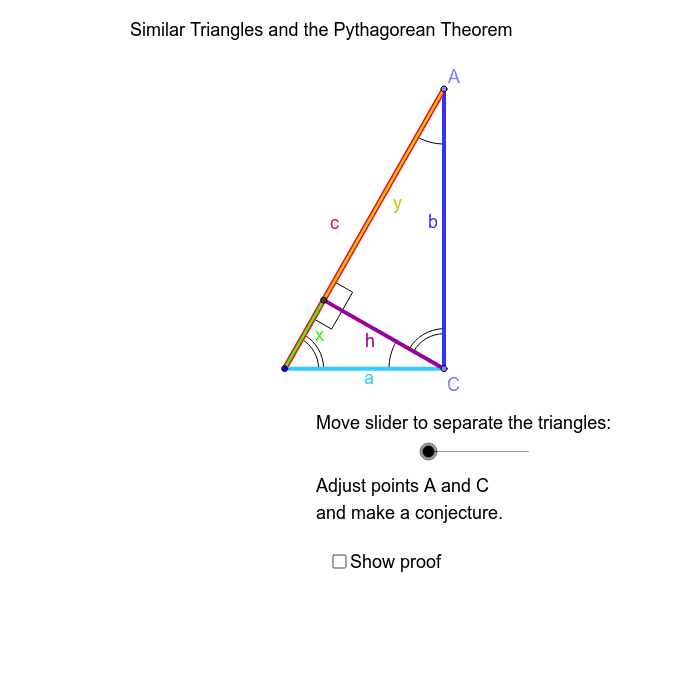
This example demonstrates the geometric relationships and properties of the Pythagorean theorem and similar triangles. Key math concepts include the Pythagorean theorem, similarity criteria and properties, vector operations, and geometric transformations. Construction highlights GeoGebra commands like Point, OrthogonalLine, Ray, Segment, Intersect, AngularBisector, Mirror, Vector, Translate, Angle, Polygon. Suitable for high school mathematics teaching and learning, providing an intuitive understanding and verification of geometric theorems.
GeoGebra Commands & Parameters
Point(xAxis) → BOrthogonalLine(B, xAxis) → aPoint(a) → CRay(B, C) → bPoint(b) → DSegment(D, B) → cSegment(A, D) → dSegment(A, B) → eOrthogonalLine(B, d) → fIntersect(f, d) → ESegment(E, B) → gSegment(D, E) → hSegment(E, A) → iAngularBisector(D, B, E) → jOrthogonalLine(B, j) → kMirror(E, k) → E'Mirror(B, k) → B'Segment(E', B') → g'Mirror(A, k) → A'Mirror(B, k) → B'_1Segment(A', B'_1) → e'Mirror(E, k) → E'_1Mirror(A, k) → A'_1Segment(E'_1, A'_1) → i'AngularBisector(A', B, E') → lMirror(E, l) → E'_2Mirror(B, l) → B'_2Segment(E'_2, B'_2) → g'_1Mirror(D, l) → D'Mirror(B, l) → B'_3Segment(D', B'_3) → c'Mirror(D, l) → D'_1Mirror(E, l) → E'_3Segment(D'_1, E'_3) → h'Vector((0, 0), (-e - g - 0.5, 0)) → uTranslate(D', u) → D''Translate(B'_3, u) → FSegment(D'', F) → c''Translate(D'_1, u) → GTranslate(E'_3, u) → HSegment(G, H) → h''Translate(E'_2, u) → ITranslate(B'_2, u) → JSegment(I, J) → mVector(E'_1, (x(F) - 0.5, 0)) → vTranslate(E'_1, v) → KTranslate(A'_1, v) → LSegment(K, L) → i''Translate(A', v) → A''Translate(B'_1, v) → MSegment(A'', M) → e''Translate(E', v) → E''Translate(B', v) → B''Segment(E'', B'') → g''Segment(C3, C2) → nSegment(C2, C1) → pSegment(C3, C1) → qSegment(C6, C7) → rSegment(C7, C5) → tSegment(C5, C6) → a_1Angle(C1, C2, C3) → αAngle(C6, C5, C7) → βAngle(A, D, B) → γAngle(E, B, A) → δAngle(C3, C1, C2) → εAngle(C7, C6, C5) → ζAngle(B, A, E) → ηAngle(D, B, E) → θAngle(C2, C3, C1) → ιAngle(C5, C7, C6) → κAngle(A, E, B) → λAngle(B, E, D) → μSegment(N, O) → b_1Segment(Q, P) → c_1Segment(S, R) → d_1Segment(A_1, T) → e_1Segment(Z, U) → f_1Segment(W, V) → g_1Polygon(B_1, C_1, E_1, D_1) → poly1, b_2, c_2, e_2, d_2
AI Drawing Prompt Reference
Draw a right triangle with a point on the x-axis, perpendicular line to the x-axis, and ray extending from the intersection point. Connect these points to form a triangle. From the right angle, draw a perpendicular line to the hypotenuse and connect the intersection point to the right angle. Reflect the perpendicular segment across the hypotenuse to create new points and lines. Finally, translate the entire figure along the negative x-axis to demonstrate properties of similar triangles.
The prompt above was compiled from the original drawing commands and is for reference only.