
Exploring Mean and Standard Deviation
Loading the math board and drawing, please wait…
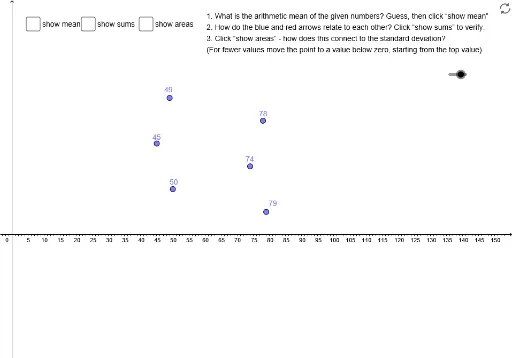
This example dynamically illustrates the concepts of mean and standard deviation. It involves core statistical concepts and allows users to observe changes in mean and standard deviation by adjusting data points. Commands used include Point, If, RemoveUndefined, Mean, Sum, Vector, Polygon, Circle, etc., suitable for high school mathematics education and learning.
GeoGebra Commands & Parameters
Point(g) → BIf(x(B) ≥ 0, x(B)) → bPoint(k) → FIf(x(F) ≥ 0, x(F)) → fPoint(j) → EIf(x(E) ≥ 0, x(E)) → ePoint(i) → DIf(x(D) ≥ 0, x(D)) → dPoint(h) → CIf(x(C) ≥ 0, x(C)) → cPoint(l) → AIf(x(A) ≥ 0, x(A)) → aRemoveUndefined(L_2) → L_1Mean(L_1) → mIf(A1 - m < 0, 1, 0) → B1Mean({a, b, c, d, e, f}) → vIf(A1 - m > 0, 1, 0) → C1If(A2 - m < 0, 1, 0) → B2If(A3 - m < 0, 1, 0) → B3If(A4 - m < 0, 1, 0) → B4If(A5 - m < 0, 1, 0) → B5If(A6 - m < 0, 1, 0) → B6If(A2 - m > 0, 1, 0) → C2If(A3 - m > 0, 1, 0) → C3If(A4 - m > 0, 1, 0) → C4If(A5 - m > 0, 1, 0) → C5If(A6 - m > 0, 1, 0) → C6Sum(D1:D6) → D7Sum(E1:E6) → E7Vector((m, 0), (m - D9, 0)) → D16Vector((m, 0), (m - D10, 0)) → D17Vector((m, 0), (m - D11, 0)) → D18Vector((m, 0), (m - D12, 0)) → D19Vector((m, 0), (m - D13, 0)) → D20Vector((m, 0), (m - D14, 0)) → D21Vector((m, 0), (m + E9, 0)) → E16Vector((m, 0), (m + E10, 0)) → E17Vector((m, 0), (m + E11, 0)) → E18Vector((m, 0), (m + E12, 0)) → E19Vector((m, 0), (m + E13, 0)) → E20Vector((m, 0), (m + E14, 0)) → E21Vector((m, (5 * sc)), (x(E), (5 * sc))) → nVector((m, (4 * sc)), (x(D), (4 * sc))) → pVector((m, (3 * sc)), (x(C), (3 * sc))) → qVector((m, (2 * sc)), (x(B), (2 * sc))) → rVector((m, sc), (x(A), sc)) → sVector((m, (6 * sc)), (x(F), (6 * sc))) → wPolygon(C15, C16, (x(C16), (-D1)), (x(C15), (-D1))) → B16, t, f_1, g_1, h_1Vector((m, 0), (m, (7 * sc))) → uPolygon(C16, C17, (x(C17), (-D2)), (x(C16), (-D2))) → B17, i_1, j_1, k_1, l_1Polygon(C17, C18, (x(C18), (-D3)), (x(C17), (-D3))) → B18, m_1, n_1, p_1, q_1Polygon(C18, C19, (x(C19), (-D4)), (x(C18), (-D4))) → B19, r_1, s_1, t_1, a_1Polygon(C19, C20, (x(C20), (-D5)), (x(C19), (-D5))) → B20, b_1, c_1, d_1, e_1Polygon(C20, C21, (x(C21), (-D6)), (x(C20), (-D6))) → B21, f_2, g_2, h_2, i_2Polygon(F15, F16, (x(F16), (-E1)), (x(F15), (-E1))) → G16, H16_1, I16, J16, K16Polygon(F16, F17, (x(F17), (-E2)), (x(F16), (-E2))) → G17, H17_1, I17, J17, K17Polygon(F17, F18, (x(F18), (-E3)), (x(F17), (-E3))) → G18, H18_1, I18, J18, K18Polygon(F18, F19, (x(F19), (-E4)), (x(F18), (-E4))) → G19, H19_1, I19, J19, K19Polygon(F19, F20, (x(F20), (-E5)), (x(F19), (-E5))) → G20, H20_1, I20, J20, K20Polygon(F20, F21, (x(F21), (-E6)), (x(F20), (-E6))) → G21, H21_1, I21, J21, K21Circle((m, 0), D7) → c_2