
Pyramid Truncated Demonstration
Loading the math board and drawing, please wait…
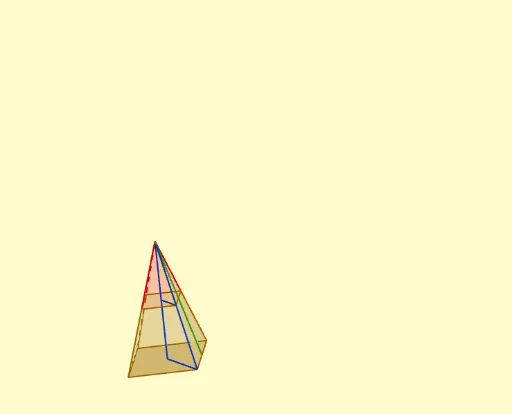
This example demonstrates the geometric construction and properties of a truncated pyramid, involving core mathematical concepts such as volume calculation, centroid determination, analytical geometry, conditional probability, and inequalities. It utilizes GeoGebra commands and objects like Intersect, Polygon, Pyramid, Centroid, Segment, Translate, and Midpoint. Suitable for high school and advanced mathematics education, covering solid geometry, coordinate geometry, and probability statistics.
GeoGebra Commands & Parameters
Intersect(xAxis, yAxis) → CPolygon(C, C', N, xOyPlane) → poly1, j, D, F, I, J, K, k, m, n, f, i, p, q, BPyramid(poly1, h_1) → a, A_2, edgeAC, edgeAC', edgeAB, edgeAD, edge1, edge2, edge3, edge4, faceACC', faceABC', faceABD, faceACD, face1, face2, face3, face4Centroid(poly1) → ESegment(C, C') → l_1IntersectPath(r, faceABC') → gIntersect(r, faceABC') → G, LIntersectPath(r, faceACC') → hIntersect(r, faceACC') → M, OIntersectPath(r, a) → poly2, P, b, c, d, m_1, f_1, g_1, i_1, Q, R, S, T, U, V, W, sPyramid(poly2, A_2) → e, faceAPQ, edgeAQ, edgeAR, edgeAS, edge5, edge6, edge7, edge8, faceAQR, faceARS, faceAPS, face5, face6, face7, face8, edgeAPSegment(E, Z) → j_1Segment(S, D) → n_1Segment(A, C) → r_1Segment(A_2, E) → q_1Segment(A_2, Z) → s_1Translate(e, Vector[(t * u)]) → e'Translate(A_2, Vector[(t * u)]) → A'Translate(A_2, Vector[(t * u)]) → A'_1Translate(Z, Vector[(t * u)]) → Z'Segment(A'_1, Z') → t_1Translate(Z, Vector[(t * u)]) → Z'_1Translate(S, Vector[(t * u)]) → S'Segment(A_2, S) → b_1Translate(A_2, Vector[(t * u)]) → A'_2Translate(S, Vector[(t * u)]) → S'_1Segment(A'_2, S'_1) → c_1Segment(A_2, M) → d_1Polygon(C', B, L, G) → q1, c', b_2, l_2, g_2Polygon(B, D, S, L) → q2, b_3, d_2, s_2, l_3Polygon(D, S, T, F) → q3, d_3, s_3, t_2, f_2Polygon(T, U, I, F) → q4, t_3, u_1, i_2, f_3Polygon(I, C, M, U) → q5, i_3, c_2, m_2, u_2Polygon(C, C', G, M) → q6, c_3, h_2, g_3, m_3Polygon(B, D, S, L) → q7, b_4, d_4, s_4, l_4Polygon(B, C', G, L) → q8, b_5, n_2, g_4, l_5Polygon(C', C, M, G) → q9, p_2, c_4, m_4, g_5Polygon(M, C, J, V) → q10, m_5, c_5, j_3, v_1Polygon(J, I, U, V) → q11, j_4, i_4, u_3, v_2Polygon(U, T, F, I) → q12, u_4, t_4, f_4, i_5Polygon(F, D, S, T) → q13, f_5, d_5, s_5, t_5Polygon(B, D, S, L) → q14, b_6, d_6, s_6, l_6Polygon(B, C', G, L) → q15, b_7, a_2, g_6, l_7Polygon(C', C, M, G) → q16, e_2, c_6, m_6, g_7Polygon(C, K, W, M) → q17, c_7, k_3, w_1, m_7Polygon(D, F, T, S) → q18, d_7, f_6, t_6, s_7Polygon(F, I, U, T) → q19, f_7, i_6, u_5, t_7Polygon(I, J, V, U) → q20, i_7, j_5, v_3, u_6Polygon(K, J, V, W) → q21, k_4, j_6, v_4, w_2Polygon(C', B, L, G) → q22, p_3, b_8, l_8, g_8Polygon(B, D, S, L) → q23, b_9, d_8, s_8, l_9Polygon(D, F, T, S) → q24, d_9, f_8, t_8, s_9Polygon(C', C, M, G) → q25, q_3, c_8, m_8, g_9Polygon(L, G, C', B) → q28, l_{10}, g_{10}, e_3, b_{10}Polygon(C, C', G, M) → q29, c_{11}, h_4, g_{11}, m_{11}Polygon(D, B, L, S) → q30, d_{11}, b_{11}, l_{11}, s_{11}Segment(G, C') → p_4Segment(E, C) → a_3Segment(S, D) → a_4Segment(Z, E) → e_4Segment(D, S) → h_5Polygon(L, M, C, B) → q31, l_{12}, m_{12}, c_{12}, b_{12}Polygon(C', B, L, G) → q32, p_5, b_{13}, l_{13}, g_{12}Polygon(C, C', G, M) → q33, c_{13}, q_5, g_{13}, m_{13}Translate(poly2, Vector[(t * u)]) → poly2'Translate(T, Vector[(t * u)]) → T'Translate(U, Vector[(t * u)]) → U'Translate(V, Vector[(t * u)]) → V'Translate(W, Vector[(t * u)]) → W'Translate(M, Vector[(t * u)]) → M'Translate(G, Vector[(t * u)]) → G'Translate(L, Vector[(t * u)]) → L'Polygon(M, W, A) → t1, a_5, m_{14}, w_3Segment(Z, E) → r_5Segment(Z, E) → e_5Midpoint(M, G) → A_1Midpoint(C, C') → B_1Segment(A_1, B_1) → h_6Segment(S, D) → k_6Segment(A, B_1) → k_1Segment(A, A_1) → n_5Translate(A, Vector[(t * u)]) → A'_{3}Translate(A_1, Vector[(t * u)]) → C_1Segment(A'_{3}, C_1) → n_6Translate(Q, Vector[(t * u)]) → Q'Translate(A_2, Vector[(t * u)]) → D_1Translate(E, Vector[(t * u)]) → E'Translate(C', Vector[(t * u)]) → C''Translate(Z, Vector[(t * u)]) → Z'_{2}Translate(G, Vector[(t * u)]) → G'_{1}Translate(M, Vector[(t * u)]) → M'_{1}Translate(Z, Vector[(t * u)]) → Z'_{3}Segment(M'_{1}, Z'_{3}) → a_1Segment(A'_{3}, M'_{1}) → p_6Segment(M, Z) → r_3Segment(C, E) → n_3Point(m_2) → E_1Segment(A, E_1) → p_1Point(t_3) → F_1Segment(A, F_1) → e_1Segment(A, U) → j_2Segment(A, V) → k_2
AI Drawing Prompt Reference
Draw a truncated pyramid, showing its geometric construction and properties. First, create the base and top faces, then connect the vertices to form the lateral faces. Mark the center points of the base and top faces and draw the line connecting them. Next, select a random point on the truncated pyramid and draw lines from this point to the top and base faces, showing their intersections. Finally, translate the truncated pyramid along the line connecting the center points to display the translated version.
The prompt above was compiled from the original drawing commands and is for reference only.