
Proving Triangles Similar Using Transformations
Loading the math board and drawing, please wait…
In collections
Similarity & Right Triangle Trigonometry
Similarity, Right Triangles, and Trigonometry (SRT) Cluster
Proving Figures Similar
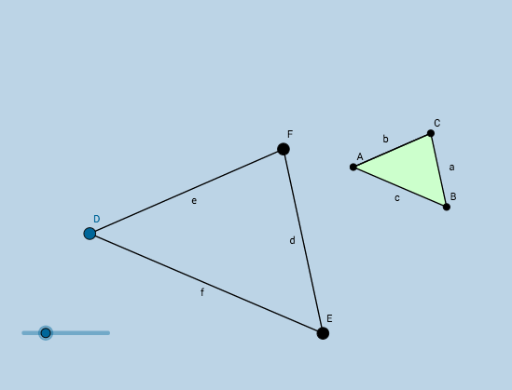
This example demonstrates proving triangles similar using geometric transformations. It covers the use of translation, rotation, reflection, and dilation to prove triangle similarity. The construction involves commands such as Ray, Rotate, Angle, Point, Segment, Polygon, Vector, Translate, and Dilate. Suitable for middle school and above students to learn methods of proving triangle similarity.
GeoGebra Commands & Parameters
Ray(D, E) → f_2Rotate(E, (a_3 * π / 180), D) → B'Angle(E, D, B') → αRay(D, B') → gPoint(g) → FSegment(F, E) → dSegment(D, E) → fPolygon(D, E, F) → poly1, c_2, a_1, b_2Segment(D, F) → eAngle(F, E, D) → βPoint(xAxis) → D_1Vector(D_1, E_1) → uPolygon(D, E, F) → poly2, c_1, a_2, b_1Translate(D, u) → ATranslate(E, u) → B'_1Translate(F, u) → C'Polygon(A, B'_1, C') → poly2', c', a', b'_1Dilate(A, d_1, A) → A''Dilate(B'_1, d_1, A) → BDilate(C', d_1, A) → CPolygon(A'', B, C) → poly2'', c, a, f_1Segment(A, C) → bSegment(C, B) → lSegment(B, A) → m
AI Drawing Prompt Reference
Start with a ray from a point, rotate another point around the first to form an angle, then pick a point on the rotated ray and connect the three points to make a triangle. Next, choose a point on the x-axis, define a translation vector, and translate the original triangle by that vector to get a congruent triangle. Then, using the first translated vertex as the center, dilate the translated triangle by a scale factor to obtain a similar triangle. Finally, connect the sides of the dilated triangle to show the similarity among the three triangles.
The prompt above was compiled from the original drawing commands and is for reference only.