
Proving Triangles Similar Using Geometric Transformations
Loading the math board and drawing, please wait…
In collections
Similarity Part 2
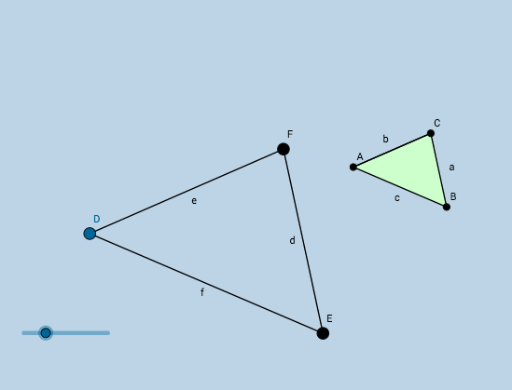
This example demonstrates proving triangles similar using geometric transformations. It covers concepts such as translation, rotation, reflection, and dilation. By constructing triangles and their transformed images, it helps students understand the properties of similar triangles. Commands used include Ray, Rotate, Angle, Point, Segment, Polygon, Vector, Translate, and Dilate. Suitable for middle school and above students learning about similar triangles.
GeoGebra Commands & Parameters
Ray(D, E) → f_2Rotate(E, (a_3 * π / 180), D) → B'Angle(E, D, B') → αRay(D, B') → gPoint(g) → FSegment(F, E) → dSegment(D, E) → fPolygon(D, E, F) → poly1, c_2, a_1, b_2Segment(D, F) → eAngle(F, E, D) → βPoint(xAxis) → D_1Vector(D_1, E_1) → uPolygon(D, E, F) → poly2, c_1, a_2, b_1Translate(D, u) → ATranslate(E, u) → B'_1Translate(F, u) → C'Polygon(A, B'_1, C') → poly2', c', a', b'_1Dilate(A, d_1, A) → A''Dilate(B'_1, d_1, A) → BDilate(C', d_1, A) → CPolygon(A'', B, C) → poly2'', c, a, f_1Segment(A, C) → bSegment(C, B) → lSegment(B, A) → m
AI Drawing Prompt Reference
Draw a triangle and its transformed image. First construct a triangle, then rotate one point. Next, construct rays and angles to assist construction. Then translate and scale the triangle to form a new triangle. Finally, draw line segments connecting points to show properties of similar triangles.
The prompt above was compiled from the original drawing commands and is for reference only.