
Proving Triangle Similarity Using Geometric Transformations (Exercise 4)
Loading the math board and drawing, please wait…
In collections
Similarity Part 2
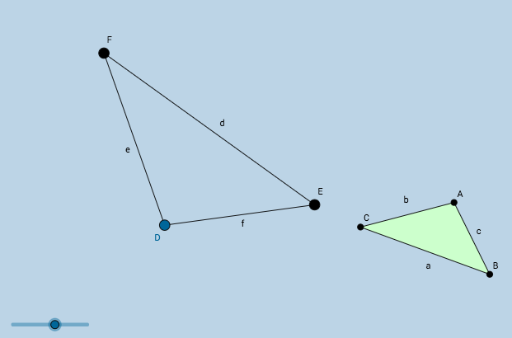
This GeoGebra example demonstrates how to prove triangles similar through geometric transformations. It covers key concepts including similarity criteria for triangles, dilation (similarity transformation), rotation, reflection, and translation. Construction highlights: Using Ray for auxiliary lines, Rotate for rotational transformation, Mirror for reflection, Dilate for scaling, combined with Point, Segment, Polygon, Line, Intersect for precise figure construction, and Angle to verify corresponding angles are equal. Ideal for middle and high school mathematics teaching - suitable for classroom demonstrations of triangle similarity criteria or as interactive exercises for students to explore geometric transformations and similarity relationships.
GeoGebra Commands & Parameters
Ray(D, E) → f_2Rotate(E, (a_2 * π / 180), D) → B'Angle(E, D, B') → αRay(D, B') → gPoint(g) → FSegment(F, E) → dSegment(D, E) → fPolygon(D, E, F) → poly1, c_1, a_1, b_1Segment(D, F) → eAngle(F, E, D) → βPoint(e) → D_1Line(D_1, d) → kIntersect(k, f) → E_1Line(I, J) → nMirror(E_1, n) → E'Mirror(D_1, n) → D'Mirror(D, n) → A'Mirror(E, n) → B'_1Mirror(F, n) → C'Polygon(A', B'_1, C') → poly1', c', a', b'_1Rotate(A', (m * π / 180), A') → ARotate(B'_1, (m * π / 180), A') → F_1Rotate(C', (m * π / 180), A') → C''Polygon(A, F_1, C'') → poly1'', c'', a'', f_1Dilate(A, d_1, A) → A'''Dilate(F_1, d_1, A) → BDilate(C'', d_1, A) → CPolygon(A''', B, C) → poly1''', c''', a''', f'Segment(A, C) → bSegment(A, B) → cSegment(B, C) → a
AI Drawing Prompt Reference
On the plane, construct a starting triangle using points D and E and additional auxiliary rays/segments to locate a third point F. Rotate D about E by a given angle to obtain B', then use rays from D through B' to intersect a prepared reference line and define F, forming triangle D–E–F. Mark the key angles (including an angle at E) for corresponding-angle checking. Create a mirrored copy of the triangle by reflecting E, D, and F across a chosen reference line to get E', D', and the reflected third vertex, giving the mirrored triangle A'–B'_1–C'. Then rotate these reflected points around the same center to place A, F_1, and C'' and draw the new triangle A–F_1–C''. Finally apply a uniform dilation with respect to the chosen center along the same scaling direction to obtain a third similar triangle A'''–B–C, and draw the corresponding side segments between the vertices.
The prompt above was compiled from the original drawing commands and is for reference only.