
Proving the Volume of a Pyramid - Solid Geometry
Loading the math board and drawing, please wait…
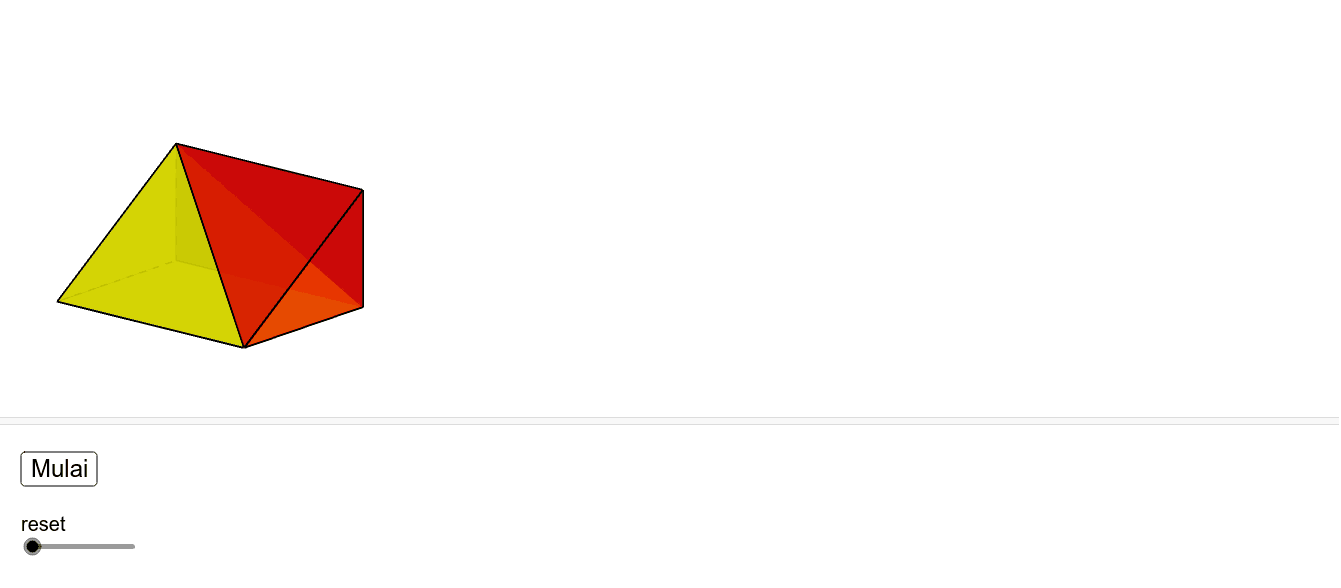
This example demonstrates how to prove the volume formula of a pyramid using geometric transformations. Key mathematical concepts include the volume calculation of a pyramid in solid geometry. Using commands like Vector, Rotate, and Translate, a pyramid is constructed and its volume is proven. Suitable for high school or university solid geometry courses.
GeoGebra Commands & Parameters
Vector((0, 0, 0), (3, 0, 3)) → vPolygon(A, D, E) → poly1, e, a, dPrism(poly1, B) → b, F_1, edgeBF, edgeFG, edgeBG, F, faceABFD, faceDEGF, faceABGE, faceBFG, edgeAB, edgeDF, edgeEGTranslate(B, Vector[(reset * v)]) → B'Translate(C, Vector[(reset * v)]) → C'Translate(F, Vector[(reset * v)]) → F'Translate(E, Vector[(reset * v)]) → E'Translate(Pyramid[Polygon[B, C, F], E], Vector[(reset * v)]) → cTranslate(Pyramid[Polygon[A, B, C, D], E], Vector[(0 * v)]) → fMidpoint(A, E) → GMidpoint(D, E) → HMidpoint(B, F) → IMidpoint(C, F) → JMidpoint(A, B) → KMidpoint(D, C) → LMidpoint(E, F) → MMidpoint(B, C) → NMidpoint(A, D) → OMidpoint(M, L) → PMidpoint(M, K) → QRotate(Prism[Polygon[D, L, P, H], O], 0°, zAxis) → gRotate(Prism[Polygon[A, O, G], K], 0°, zAxis) → hMidpoint(K, L) → RRotate(Prism[Polygon[Q, R, N], P], 0°, zAxis) → iTranslate(M, Vector[(reset * v)]) → M'Translate(P, Vector[(reset * v)]) → P'Translate(Q, Vector[(reset * v)]) → Q'Translate(I, Vector[(reset * v)]) → I'Translate(J, Vector[(reset * v)]) → J'Rotate(Prism[Polygon[I', J', F'], Q'], 0°, zAxis) → jTranslate(N, Vector[(reset * v)]) → N'Rotate(Prism[Polygon[Q', N', I'], P'], 0°, zAxis) → kVector(B, Q) → uSequence(Translate[Dilate[list1, 0.5, B'], Vector[(t * u)]], t, 0, 1) → list1'Sequence(Translate[Dilate[list2, 0.5, B], Vector[(t * u)]], t, 0, 1) → list2'Sequence(Translate[Dilate[list1, 0.25, B'], Vector[(t * u / 2)]], t, 0, 3) → list1''Sequence(Translate[Dilate[list2, 0.25, B], Vector[(t * u / 2)]], t, 0, 3) → list2''Sequence(Translate[Dilate[list1, 0.125, B'], Vector[(t * u / 4)]], t, 0, 7) → list1'''Sequence(Translate[Dilate[list2, 0.125, B], Vector[(t * u / 4)]], t, 0, 7) → list2'''Sequence(Translate[Dilate[list1, 0.0625, B'], Vector[(t * u / 8)]], t, 0, 15) → list1''''Sequence(Translate[Dilate[list2, 0.0625, B], Vector[(t * u / 8)]], t, 0, 15) → list2''''Translate(Pyramid[Polygon[B, C, F], E], Vector[(reset * v)]) → c'Translate(Pyramid[Polygon[A, B, C, D], E], Vector[(0 * v)]) → f'Rotate(Prism[Polygon[D, L, P, H], O], 0°, zAxis) → g'Rotate(Prism[Polygon[A, O, G], K], 0°, zAxis) → h'Rotate(Prism[Polygon[Q, R, N], P], 0°, zAxis) → i'Rotate(Prism[Polygon[I', J', F'], Q'], 0°, zAxis) → j'Rotate(Prism[Polygon[Q', N', I'], P'], 0°, zAxis) → k'
AI Drawing Prompt Reference
Draw a pyramid with base triangle BCF and apex E. Construct the pyramid's faces using translations and rotations to prove its volume formula. Start by creating vector v, then construct the base polygon, build the pyramid, translate its faces, rotate its edges, and finally show the scaling effect of the pyramid's faces through scaling and translation.
The prompt above was compiled from the original drawing commands and is for reference only.