
Proving Parallelograms Example
Loading the math board and drawing, please wait…
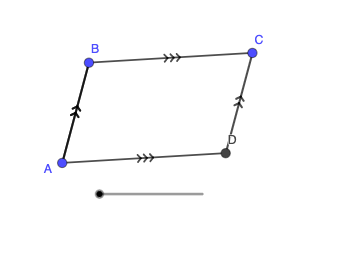
This example demonstrates how to prove the properties of a parallelogram through construction and measurement. Key math concepts involved include parallel lines, diagonals, segment lengths, and angles. Construction highlights involve using GeoGebra commands like Segment, Line, Intersect, and Translate with objects A, B, f, C, g, h, i, D, j, k, n, A', B', f'. Suitable for middle school and above students to learn and understand the geometric properties of parallelograms, ideal for classroom instruction or self-exploration.
GeoGebra Commands & Parameters
Segment(A, B) → fSegment(B, C) → gLine(A, g) → hLine(C, f) → iIntersect(h, i) → DSegment(A, D) → jSegment(D, C) → kTranslate(A, (n * (D - A))) → A'Translate(B, (n * (D - A))) → B'Segment(A', B') → f'
AI Drawing Prompt Reference
Draw a parallelogram ABCD, connect point A and point B to get segment f; connect point B and point C to get segment g; draw a line through point A parallel to line g, and a line through point C parallel to line f; these two lines intersect at point D; connect point A and point D to get segment j; connect point D and point C to get segment k; translate point A by vector (D-A) n times to get point A'; translate point B by vector (D-A) n times to get point B'; connect point A' and point B' to get segment f'.
The prompt above was compiled from the original drawing commands and is for reference only.