
Proving Angles Congruent
Loading the math board and drawing, please wait…
In collections
Congruence (CO) Cluster
Congruence (Vol 1)
Congruence (Vol 1) Over 80 Resources
CCSS High School: Geometry (Congruence) Volume 1 S N ATTAR
Geometry (Congruence) Volume 1
CCSS High School: Geometry (Congruence) Volume 1
CCSS High School: Geometry (Congruence) Volume 1
CCSS High School: Geometry (Congruence) Volume 1
CCSS High School: Geometry (Congruence) Volume 1
CCSS High School: Geometry (Congruence) Volume 1
CCSS High School: Geometry (Congruence) Volume 1
CCSS High School: Geometry (Congruence) Volume 1
CCSS High School: Geometry (Congruence) Volume 1
CCSS High School: Geometry (Congruence) Volume 1
CCSS High School: Geometry (Congruence) Volume 1
CCSS High School: Geometry (Congruence) Volume 1
Geometry: Introductory Definitions, Postulates, Theorems
Congruence: Volume 1 - Chapter 1
Congruence V1C1 Check
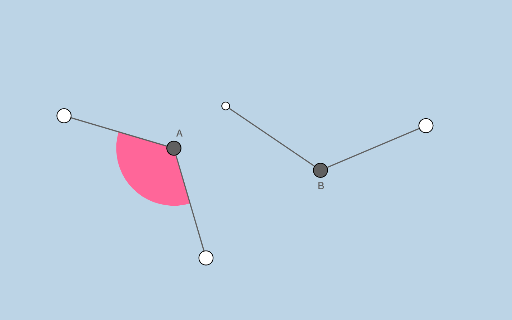
This example demonstrates how to prove angles congruent using transformational geometry. Core math concepts include angles, rotation, circles, and intersection points. GeoGebra commands like Point, Segment, Max, Rotate, and Circle are utilized in the construction. Suitable for high school mathematics education, helping students understand and apply geometric transformations.
GeoGebra Commands & Parameters
Point(xAxis) → A_1Segment(A_1, A) → fMax(x(A_1), x(A)) → aPointIn(b) → BCircle(B, f) → cPoint(c) → DSegment(B, D) → gCircle(A, A_1) → dLine(A, A_1) → hIntersect(d, h, 2) → FCircleArc(A, A_1, F) → ePoint(e) → EAngle(A_1, A, E) → αRotate(D, α, B) → D'Segment(A, E) → iSegment(B, D') → jCircle(A, (0.5 * f)) → kIntersect(k, f) → G,Intersect(k, i) → H,Circle(B, (0.5 * f)) → pIntersect(p, g, 1) → IIntersect(p, j, 1) → JCircleSector(A, G, H) → qCircleSector(B, I, J) → rSegment(A, A_1) → lSegment(A, E) → mSegment(B, D) → nSegment(B, D') → s
AI Drawing Prompt Reference
Draw a geometric diagram to demonstrate proving angles congruent through rotational transformation. Start by drawing a line segment and two circles with the endpoints as centers, intersecting at two points. Connect these points to the segment endpoint, forming two angles. Rotate one angle so that its vertex aligns with the circle's center, observing if the angles overlap to prove congruence.
The prompt above was compiled from the original drawing commands and is for reference only.