
Properties of a Trapezium by Andrea Morgan
Loading the math board and drawing, please wait…
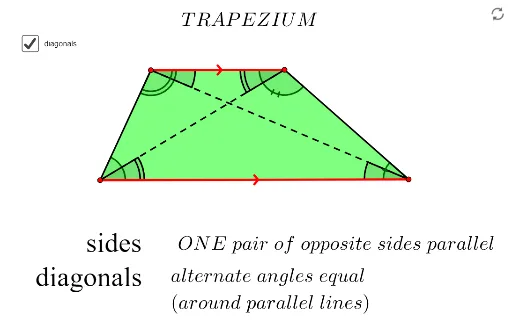
This example demonstrates the properties of a trapezium. Key mathematical concepts include the definition of a trapezium, the midsegment theorem, and angle relationships. Using GeoGebra commands such as Segment, Line, Point, and Polygon, the construction process is dynamically illustrated. Suitable for middle and high school students learning geometric construction and related properties.
GeoGebra Commands & Parameters
Segment(A, B) → a_2Line(C, a_2) → b_2Point(b_2) → DPolygon(A, C, D, B) → P, a_1, a, d, bMidpoint(D, B) → ELine(A, B) → eOrthogonalLine(D, e) → fIntersect(f, e) → FMidpoint(a_2) → LSegment(A, D) → cSegment(C, B) → gAngle(B, C, D) → αAngle(C, B, A) → βAngle(C, D, A) → γAngle(B, A, D) → δAngle(A, C, D) → εAngle(C, D, B) → ζAngle(D, B, A) → ηAngle(B, A, C) → θ
AI Drawing Prompt Reference
Draw a trapezium and illustrate the midsegment theorem and angle relationships. Start by constructing the four sides of the trapezium, then find the midpoint of one side and draw a line segment through it parallel to the base. Next, measure and label the sizes of all interior angles, highlighting the relationships between the angles and the midsegment. Finally, use different colors or styles to distinguish key parts for clarity.
The prompt above was compiled from the original drawing commands and is for reference only.