
Properties of a Perpendicular Bisector: Dynamic Exploration
Loading the math board and drawing, please wait…
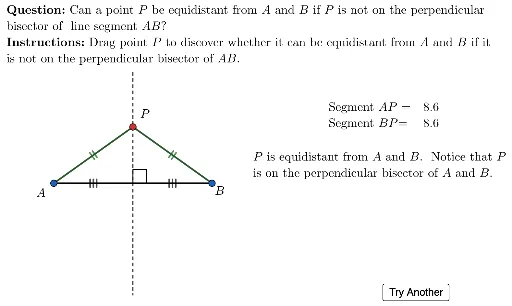
①This interactive GeoGebra example dynamically demonstrates the key property of a perpendicular bisector: any point on the bisector is equidistant from the endpoints of the segment.②Core mathematical concepts include the definition of a perpendicular bisector, midpoint, distance equality, congruent triangles (used for proof), and symmetry transformations.③Construction highlights: the LineBisector command creates the perpendicular bisector, Midpoint identifies the center, Segment connects points to endpoints, Angle and TableText display measurements, DynamicCoordinates enables dragging point P, and Mirror/Polygon support symmetric constructions. As P moves, lengths AP and BP update in real time, visually confirming equality.④This resource is ideal for middle school geometry lessons on bisector properties and introductory geometric proofs, and also serves as a visual foundation for locus concepts in high school coordinate geometry.
GeoGebra Commands & Parameters
Polygon({(left, bottom), (left, top), (right, top), (right, bottom)}) → viewboxPointIn(viewbox) → K_PMirror(B, yAxis) → ASegment(A, B) → ABLineBisector(AB) → perpBisectorLaTeX((((("\text{" * MainInstruc) * "\\") * SpecInstruc) * "}")) → InstrucCompleteDynamicCoordinates(K_P, If[Distance[K_P, perpBisector] < 0.2, 0, x(K_P)], y(K_P)) → PSegment(B, P) → segAPSegment(A, P) → segBPAngle(AB, perpBisector) → αTableText({{"\text{Segment \(AP\) =}", "\text{Segment \(BP\)=}"}, {("" * segAP), ("" * segBP)}}, "v") → textDataMidpoint(A, B) → centerSegment(A, center) → segAOSegment((0, 0), B) → segOB