
Properties of a Parallelogram by Jovena Sim
Loading the math board and drawing, please wait…
In collections
Parallelogram
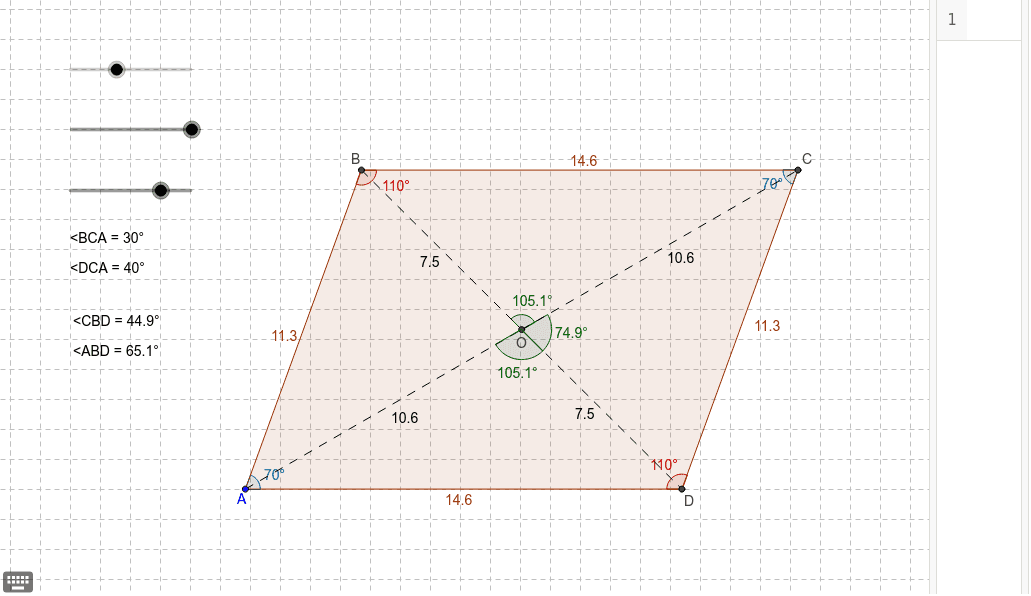
This example demonstrates the properties of a parallelogram, including equal opposite sides, equal opposite angles, and bisecting diagonals. Using GeoGebra commands such as Rotate, Ray, Segment, and Line, a parallelogram is constructed and its properties are observed. Suitable for middle school and above students to learn geometric construction.
GeoGebra Commands & Parameters
Rotate(B_1, α, A) → ERotate(B_1, α, D) → D_1Ray(D, D_1) → bSegment(A, B_1) → aLine(B, a) → fIntersect(b, f) → CAngle(A, C, D) → λAngle(B_1, D, D_1) → βAngle(B_1, A, E) → γRay(A, E) → cPolygon(A, B, C, D) → P, a_1, g, f_1, c_1Segment(B, D) → hSegment(A, C) → iIntersect(h, i) → OSegment(B, O) → jSegment(O, D) → kSegment(A, O) → lSegment(O, C) → mAngle(C, O, B) → δAngle(B, C, A) → εAngle(D, A, C) → ζAngle(A, B, C) → ηAngle(C, D, A) → θAngle(B, C, D) → ιAngle(D, A, B) → κAngle(C, B, D) → μAngle(A, B, D) → νAngle(C, O, D) → ξAngle(A, O, D) → ο
AI Drawing Prompt Reference
Draw a parallelogram ABCD. Rotate point B around point A to get point E, and rotate point B around point D to get point D1. Connect line segments AD and B1E, and let them intersect at point C. Construct the parallelogram ABCD and observe its properties of equal opposite sides, equal opposite angles, and bisecting diagonals.
The prompt above was compiled from the original drawing commands and is for reference only.