
Proofs without Words: Exterior Angles of Polygons
Loading the math board and drawing, please wait…
In collections
Polygons & Angles
Polygons & Angles
Polygons & Angles ( s n attar)
Polygons & Angles
Polygons & Angles
Polygons & Angles
Polygons & Angles
Geometry: Polygons & Angles
Geometry: Polygons & Angles
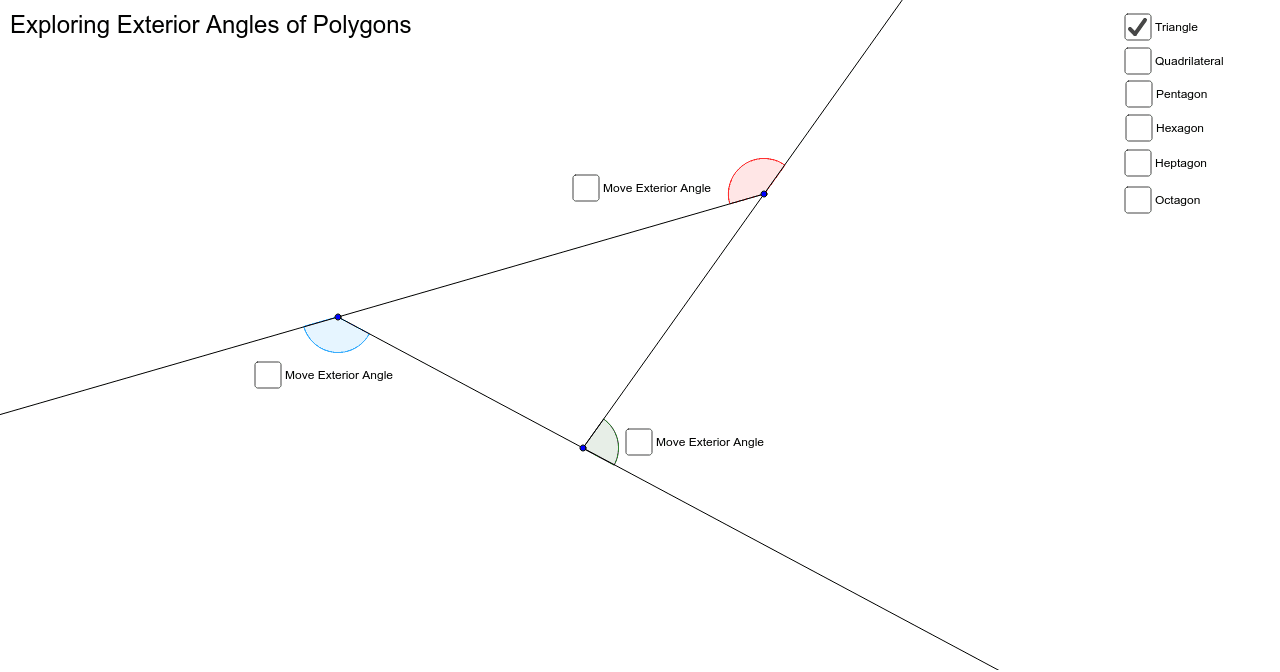
This interactive applet provides a visual 'proof without words' demonstrating that the sum of the exterior angles of any convex polygon is always 360 degrees. The mathematical focus is on the properties of convex polygons and the constant sum of their exterior angles. The construction employs GeoGebra commands such as Ray, Vector, and Translate to shift each exterior angle to a common vertex, utilizing Segment, Point, and Intersect to form a complete circle. This tool is ideal for middle school geometry students and educators to intuitively grasp polygon theorems through dynamic visualization.
GeoGebra Commands & Parameters
Ray(A, B) → aRay(B, C) → bRay(C, A) → cVector(B, D) → uVector(C, D) → vVector(A, D) → wPoint(a) → EPoint(b) → FPoint(b) → GPoint(c) → HPoint(c) → IPoint(a) → JSegment(B, E) → eSegment(B, F) → fSegment(C, G) → gSegment(C, H) → hSegment(A, I) → iSegment(A, J) → jTranslate(B, u) → B'_1Distance(B, D) → distanceBDPoint(a) → KPoint(b) → LSegment(B, K) → lSegment(B, L) → mTranslate(B, u) → B'Translate(K, u) → K'Segment(B', K') → l'Translate(B, u) → B'_2Translate(L, u) → L'Segment(B'_2, L') → m'Translate(C, v) → C'Translate(G, v) → G'Segment(C', G') → g'Translate(C, v) → C'_1Translate(H, v) → H'Segment(C'_1, H') → h'Translate(A, w) → A'Translate(I, w) → I'Segment(A', I') → i'Translate(A, w) → A'_1Translate(J, w) → J'Segment(A'_1, J') → j'Ray(D, H') → p_1Circle(D, H') → q_1Ray(D, G') → r_1Intersect(q_1, r_1) → M,Ray(D, K') → s_1Intersect(q_1, s_1) → N,CircleSector(D, G', H') → tCircle(D, M) → d_1Circle(A, 1) → f_1Circle(B, 1) → g_1Circle(C, 1) → h_1Intersect(h_1, b, 2) → OIntersect(h_1, c, 1) → PIntersect(f_1, c, 2) → QIntersect(f_1, a, 1) → RIntersect(g_1, a, 2) → SIntersect(g_1, b, 1) → TCircleSector(A, Q, R) → ext_3CircleSector(B, S, T) → ext_1CircleSector(C, O, P) → ext_2Translate(ext_3, w) → k'Translate(ext_1, u) → k_1Translate(ext_2, v) → ext_4Ray(U, V) → a_1Ray(V, W) → b_1Ray(W, Z) → c_1Ray(Z, U) → e_1Circle(V, 1) → t_1Circle(W, 1) → c_2Circle(Z, 1) → d_2Circle(U, 1) → e_2Intersect(t_1, a_1, 2) → A_1Intersect(t_1, b_1, 1) → B_1Intersect(c_2, b_1, 2) → C_1Intersect(c_2, c_1, 1) → D_1Intersect(d_2, c_1, 2) → E_1Intersect(d_2, e_1, 1) → F_1Intersect(e_2, e_1, 2) → G_1Intersect(e_2, a_1, 1) → H_1CircleSector(V, A_1, B_1) → f_2CircleSector(W, C_1, D_1) → g_2CircleSector(Z, E_1, F_1) → h_2CircleSector(U, G_1, H_1) → k_2Vector(U, I_1) → u_1Vector(V, I_1) → v_1Vector(W, I_1) → w_1Vector(Z, I_1) → i_1Translate(k_2, u_1) → p_2Translate(f_2, v_1) → q_2Translate(g_2, w_1) → r_2Translate(h_2, i_1) → s_2Ray(J_1, K_1) → dRay(K_1, L_1) → a_2Ray(L_1, M_1) → b_2Ray(M_1, N_1) → i_2Ray(N_1, J_1) → j_2Circle(J_1, 1) → t_2Circle(K_1, 1) → c_3Circle(L_1, 1) → d_3Circle(M_1, 1) → e_3Circle(N_1, 1) → f_3Intersect(t_2, j_2, 2) → O_1Intersect(t_2, d, 1) → P_1Intersect(c_3, d, 2) → Q_1Intersect(c_3, a_2, 1) → R_1Intersect(d_3, a_2, 2) → S_1Intersect(d_3, b_2, 1) → T_1Intersect(e_3, b_2, 2) → U_1Intersect(e_3, i_2, 1) → V_1Intersect(f_3, i_2, 2) → W_1Intersect(f_3, j_2, 1) → Z_1CircleSector(J_1, O_1, P_1) → g_3CircleSector(K_1, Q_1, R_1) → h_3CircleSector(L_1, S_1, T_1) → k_3CircleSector(M_1, U_1, V_1) → p_3CircleSector(N_1, W_1, Z_1) → q_3Vector(J_1, A_2) → u_2Vector(K_1, A_2) → v_2Vector(L_1, A_2) → w_2Vector(M_1, A_2) → l_2Vector(N_1, A_2) → m_2Translate(g_3, u_2) → r_3Translate(h_3, v_2) → s_3Translate(k_3, w_2) → t_3Translate(q_3, m_2) → c_4Translate(p_3, l_2) → d_4Ray(B_2, C_2) → l_3Ray(C_2, D_2) → m_3Ray(D_2, E_2) → q_6Ray(E_2, F_2) → a_4Ray(F_2, G_2) → b_4Ray(G_2, B_2) → e_4Circle(B_2, 1) → f_4Circle(C_2, 1) → g_4Circle(D_2, 1) → h_4Circle(E_2, 1) → k_4Circle(F_2, 1) → p_4Circle(G_2, 1) → q_4Intersect(q_4, b_4, 2) → H_2Intersect(q_4, e_4, 1) → I_2Intersect(f_4, e_4, 2) → J_2Intersect(f_4, l_3, 1) → K_2Intersect(g_4, l_3, 2) → L_2Intersect(g_4, m_3, 1) → M_2Intersect(h_4, m_3, 2) → N_2Intersect(h_4, q_6, 1) → O_2Intersect(k_4, q_6, 2) → P_2Intersect(k_4, a_4, 1) → Q_2Intersect(p_4, a_4, 2) → R_2Intersect(p_4, b_4, 1) → S_2CircleSector(F_2, R_2, S_2) → r_4CircleSector(G_2, H_2, I_2) → s_4CircleSector(B_2, J_2, K_2) → t_4CircleSector(C_2, L_2, M_2) → c_5CircleSector(D_2, N_2, O_2) → d_5CircleSector(E_2, P_2, Q_2) → e_5Vector(B_2, T_2) → u_3Vector(C_2, T_2) → v_3Vector(D_2, T_2) → w_3Vector(E_2, T_2) → n_3Vector(F_2, T_2) → u_4Vector(G_2, T_2) → v_4Translate(s_4, v_4) → f_5Translate(t_4, u_3) → g_5Translate(c_5, v_3) → h_5Translate(d_5, w_3) → k_5Translate(e_5, n_3) → p_5Translate(r_4, u_4) → q_5Ray(U_2, V_2) → i_4Ray(V_2, W_2) → j_4Ray(W_2, Z_2) → l_4Ray(Z_2, A_3) → m_4Ray(A_3, B_3) → n_4Ray(B_3, C_3) → a_5Ray(C_3, U_2) → b_5Circle(B_3, 1) → r_5Circle(C_3, 1) → s_5Circle(U_2, 1) → t_5Circle(V_2, 1) → c_6Circle(W_2, 1) → d_6Circle(Z_2, 1) → e_6Circle(A_3, 1) → f_6Intersect(r_5, n_4, 2) → D_3Intersect(r_5, a_5, 1) → E_3Intersect(s_5, a_5, 2) → F_3Intersect(s_5, b_5, 1) → G_3Intersect(t_5, b_5, 2) → H_3Intersect(t_5, i_4, 1) → I_3Intersect(c_6, i_4, 2) → J_3Intersect(c_6, j_4, 1) → K_3Intersect(d_6, j_4, 2) → L_3Intersect(d_6, l_4, 1) → M_3Intersect(e_6, l_4, 2) → N_3Intersect(e_6, m_4, 1) → O_3Intersect(f_6, m_4, 2) → P_3Intersect(f_6, n_4, 1) → Q_3CircleSector(B_3, D_3, E_3) → g_6CircleSector(C_3, F_3, G_3) → h_6CircleSector(U_2, H_3, I_3) → k_6CircleSector(V_2, J_3, K_3) → p_6CircleSector(W_2, L_3, M_3) → r_6CircleSector(Z_2, N_3, O_3) → s_6CircleSector(A_3, P_3, Q_3) → t_6Vector(U_2, R_3) → w_4Vector(V_2, R_3) → u_5Vector(W_2, R_3) → v_5Vector(Z_2, R_3) → w_5Vector(A_3, R_3) → i_5Vector(B_3, R_3) → j_5Vector(C_3, R_3) → l_5Translate(g_6, j_5) → c_7Translate(h_6, l_5) → d_7Translate(k_6, w_4) → e_7Translate(p_6, u_5) → f_7Translate(r_6, v_5) → g_7Translate(s_6, w_5) → h_7Translate(t_6, i_5) → k_7Ray(S_3, T_3) → m_5Ray(T_3, U_3) → n_5Ray(U_3, V_3) → a_6Ray(V_3, W_3) → b_6Ray(W_3, Z_3) → i_6Ray(Z_3, A_4) → j_6Ray(A_4, B_4) → l_6Ray(B_4, S_3) → m_6Circle(A_4, 1) → p_7Circle(B_4, 1) → q_7Circle(S_3, 1) → r_7Circle(T_3, 1) → s_7Circle(U_3, 1) → t_7Circle(V_3, 1) → c_8Circle(W_3, 1) → d_8Circle(Z_3, 1) → e_8Intersect(q_7, l_6, 2) → C_4Intersect(q_7, m_6, 1) → D_4Intersect(r_7, m_6, 2) → E_4Intersect(r_7, m_5, 1) → F_4Intersect(s_7, m_5, 2) → G_4Intersect(s_7, n_5, 1) → H_4Intersect(t_7, n_5, 2) → I_4Intersect(t_7, a_6, 1) → J_4Intersect(c_8, a_6, 2) → K_4Intersect(c_8, b_6, 1) → L_4Intersect(d_8, b_6, 2) → M_4Intersect(d_8, i_6, 1) → N_4Intersect(e_8, i_6, 2) → O_4Intersect(e_8, j_6, 1) → P_4Intersect(p_7, j_6, 2) → Q_4Intersect(p_7, l_6, 1) → R_4CircleSector(A_4, Q_4, R_4) → f_8CircleSector(B_4, C_4, D_4) → g_8CircleSector(S_3, E_4, F_4) → h_8CircleSector(T_3, G_4, H_4) → k_8CircleSector(U_3, I_4, J_4) → p_8CircleSector(V_3, K_4, L_4) → q_8CircleSector(W_3, M_4, N_4) → r_8CircleSector(Z_3, O_4, P_4) → s_8Vector(S_3, S_4) → u_6Vector(T_3, S_4) → v_6Vector(U_3, S_4) → w_6Vector(V_3, S_4) → n_6Vector(W_3, S_4) → u_7Vector(Z_3, S_4) → v_7Vector(A_4, S_4) → w_7Vector(B_4, S_4) → a_7Translate(k_8, v_6) → t_8Translate(p_8, w_6) → c_9Translate(q_8, n_6) → d_9Translate(r_8, u_7) → e_9Translate(s_8, v_7) → f_9Translate(f_8, w_7) → g_9Translate(g_8, a_7) → h_9Translate(h_8, u_6) → k_9
AI Drawing Prompt Reference
Draw a convex polygon and show its exterior angles. Translate each exterior angle to a common vertex to form a complete circle. Use dynamic visualization to demonstrate that the sum of exterior angles is always 360 degrees. The graphic should clearly show the relationship between the polygon and the circle to help understand geometric theorems.
The prompt above was compiled from the original drawing commands and is for reference only.