
Proof Without Words: Pythagorean Theorem via Rotation and Area
Loading the math board and drawing, please wait…
In collections
Similarity & Right Triangle Trigonometry
Similarity, Right Triangles, and Trigonometry (SRT) Cluster
Proofs Without Words
Proofs Without Words
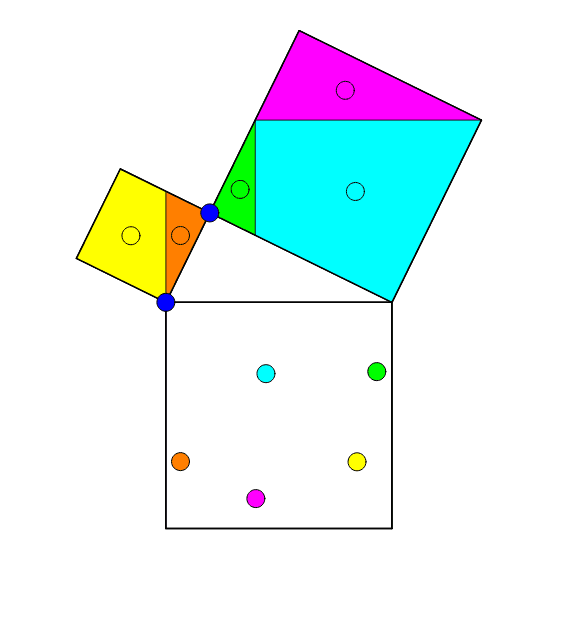
① This interactive GeoGebra example demonstrates a visual proof of the Pythagorean theorem without words, where dragging points reveals how areas relate. ② Core mathematical concepts include the Pythagorean theorem, rotation, mirroring, area decomposition, and properties of right triangles, rectangles, and angles; it also touches on inequalities and real numbers. ③ Construction highlights: from the summary, commands such as Point, Intersect, Mirror, CircleArc, Segment, Polygon, Line, OrthogonalLine, Ray, Vector, Centroid, and Translate are used to create multiple points, segments, polygons, arcs, and vectors, forming four polygonal regions that illustrate the area equality. ④ Suitable for middle and high school students learning the Pythagorean theorem, as well as for teachers seeking a dynamic visual proof to support geometric reasoning and inquiry-based learning.
GeoGebra Commands & Parameters
Point(xAxis) → AIntersect(xAxis, yAxis) → BMirror(A, B) → A'CircleArc(B, C, A) → cPoint(c) → DSegment(A, D) → aSegment(D, A') → bPolygon(D, A', 4) → poly1, d, e, f, g, E, FPolygon(A', A, 4) → poly2, h, i, j, k, G, HPolygon(A, D, 4) → poly3, l, m, n, p, I, JLine(E, h) → qIntersect(q, g) → KOrthogonalLine(K, h) → rRay(G, A) → sIntersect(r, d) → LIntersect(m, s) → MPolygon(L, K, E, A') → poly4, l_1, k_1, e_1, a'Polygon(L, K, D) → poly5, d_1, l_2, k_2Polygon(K, F, E) → poly6, e_2, k_3, f_1Polygon(M, A, D) → poly7, d_2, m_1, a_1Polygon(M, I, J, A) → poly8, m_2, i_1, j_1, a_2Vector(A, H) → uVector(E, H) → vVector(E, A') → wVector(K, A') → tVector(A, G) → u_1Centroid(poly5) → NCentroid(poly6) → OCentroid(poly7) → PCentroid(poly8) → QCentroid(poly4) → RTranslate(R, w) → R'Translate(O, v) → O'Translate(N, t) → N'Translate(P, u_1) → P'Translate(Q, u) → Q'Segment(P, P') → b_1Segment(Q, Q') → c_1Segment(R, R') → g_1Segment(N, N') → h_1Segment(O, O') → n_1Point(n_1) → SVector(O, S) → v_1Point(g_1) → TVector(R, T) → w_1Point(h_1) → UVector(N, U) → p_1Point(b_1) → VVector(P, V) → q_1Point(c_1) → WVector(Q, W) → r_1Translate(L, p_1) → L'Translate(K, p_1) → K'Translate(D, p_1) → D'Polygon(L', K', D') → poly5', d', l', k'Translate(K, v_1) → K'_1Translate(F, v_1) → F'Translate(E, v_1) → E'Polygon(K'_1, F', E') → poly6', e', k'_1, f'Translate(M, q_1) → M'Translate(A, q_1) → A'_1Translate(D, q_1) → D'_1Polygon(M', A'_1, D'_1) → poly7', d'_1, m', a'_1Translate(L, w_1) → L'_1Translate(K, w_1) → K'_2Translate(E, w_1) → E'_1Translate(A', w_1) → A''Polygon(L'_1, K'_2, E'_1, A'') → poly4', l'_1, k'_2, e'_1, a''Translate(M, r_1) → M'_1Translate(I, r_1) → I'Translate(J, r_1) → J'Translate(A, r_1) → A'_2Polygon(M'_1, I', J', A'_2) → poly8', m'_1, i', j', a'_2
AI Drawing Prompt Reference
On a coordinate plane, place a point on the x-axis and its reflection across the origin. Draw a circular arc centered at the origin passing through the x-axis point and the y-axis point, then pick a point on the arc. Connect this point to the x-axis point and its reflection to form a right triangle. Construct three squares outward on the three sides of the triangle. Use rotation and mirroring to create auxiliary lines, dividing the large square into several polygonal pieces. Translate these pieces so they exactly fill the two smaller squares, visually proving that the area of the square on the hypotenuse equals the sum of the areas of the squares on the other two sides.
The prompt above was compiled from the original drawing commands and is for reference only.