
Proof Without Words: Pythagorean Theorem by Steve Phelps (4)
Loading the math board and drawing, please wait…
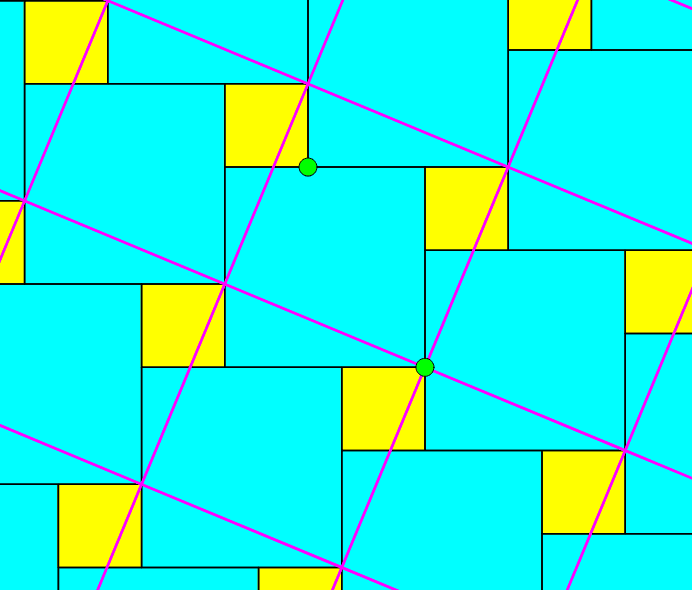
① This interactive GeoGebra example demonstrates the Pythagorean theorem through a visual, drag-and-drop geometric construction, requiring no verbal explanation. ② The core mathematical concept is the Pythagorean theorem, involving right triangles, areas of squares, vector translations, and mirror symmetries. ③ Construction details: using GeoGebra commands such as Point, Polygon, Midpoint, Mirror, Vector, Translate, and Sequence, the example builds a right triangle with squares on each side, then applies reflections and translations to create congruent shapes that visually prove the area equality a² + b² = c². ④ Suitable for middle school or high school geometry classes, ideal for inquiry-based learning, helping students observe patterns, make conjectures, and understand the geometric proof of the Pythagorean theorem.
GeoGebra Commands & Parameters
Point(xAxis) → APoint(xAxis) → BPolygon(A, B, 4) → poly1, a, b, c, d, C, DPoint(c) → EPolygon(D, E, 4) → poly2, e, f, g, h, F, GMidpoint(G, A) → HMirror(poly2, H) → poly2'Mirror(poly1, H) → poly1'Mirror(D, H) → D'Vector(D', F) → uVector(D', B) → vTranslate(poly2, u) → poly2'_1Sequence(Sequence[Translate[poly1, Vector[(a * u) + (b * v)]], a, -5, 5], b, -5, 5) → list1Sequence(Sequence[Translate[poly2, Vector[(a * u) + (b * v)]], a, -5, 5], b, -5, 5) → list2Sequence(Sequence[PolyLine[Translate[A, Vector[(a * u) + (b * v)]], Translate[D, Vector[(a * u) + (b * v)]], Translate[C, Vector[(a * u) + (b * v)]], Translate[B, Vector[(a * u) + (b * v)]], Translate[A, Vector[(a * u) + (b * v)]]], a, -5, 5], b, -5, 5) → list3Sequence(Sequence[PolyLine[Translate[D, Vector[(a * u) + (b * v)]], Translate[G, Vector[(a * u) + (b * v)]], Translate[F, Vector[(a * u) + (b * v)]], Translate[E, Vector[(a * u) + (b * v)]], Translate[D, Vector[(a * u) + (b * v)]]], a, -5, 5], b, -5, 5) → list4Sequence(Sequence[Translate[PolyLine[D', F, F + v, B, D'], Vector[(a * u) + (b * v)]], a, -5, 5], b, -5, 5) → list5
AI Drawing Prompt Reference
Draw a right triangle and construct squares on each of its sides. Visually demonstrate the Pythagorean theorem by using reflections and vector translations to show how the squares can be rearranged to form congruent shapes, proving that the sum of the areas of the two smaller squares equals the area of the largest square.
The prompt above was compiled from the original drawing commands and is for reference only.