
Triangle Congruence Criteria: Angle-Angle-Angle (AAA) Demonstration
Loading the math board and drawing, please wait…
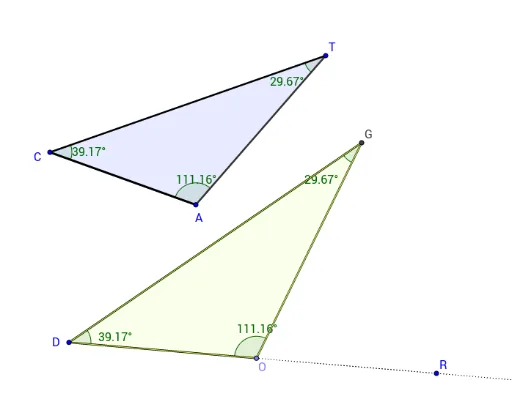
①This example dynamically demonstrates the Angle-Angle-Angle (AAA) criterion for triangle congruence, showing that having three corresponding equal angles does not guarantee congruence but rather similarity.②Core mathematical concepts include the distinction between triangle congruence and similarity, the role of AAA as a similarity criterion, and comparison with actual congruence criteria like SAS, ASA, and SSS.③Construction highlights: using GeoGebra commands such as Polygon, Ray, Point, Circle, Intersect, Segment, and Angle, two triangles are constructed with adjustable vertices; dragging vertices reveals that equal angles lead to proportional sides but not equal side lengths, illustrating why AAA fails as a congruence test.④This is suitable for middle or high school geometry classes, helping students grasp the conditions for triangle congruence and similarity, and can be used for teacher demonstrations or student exploration.
GeoGebra Commands & Parameters
Polygon(C, A, T) → poly1, c, a, bRay(D, R) → dPoint(c) → FCircle(C, F) → eIntersect(e, b, 1) → G_1Circle(D, Segment[C, F]) → fIntersect(f, d, 1) → HCircle(H, Segment[F, G_1]) → gIntersect(f, g, 1) → IRay(D, I) → hPoint(d) → OPoint(c) → KCircle(A, K) → kCircle(O, Segment[A, K]) → pIntersect(k, a, 1) → LIntersect(p, d, 1) → MCircle(M, Segment[K, L]) → qIntersect(p, q, 2) → NRay(O, N) → iIntersect(h, i) → GSegment(D, G) → jSegment(G, O) → lSegment(O, D) → mAngle(A, C, T) → αAngle(O, D, G) → βPolygon(D, O, G) → poly2, o, d_1, j_1Angle(C, T, A) → γAngle(T, A, C) → δAngle(D, G, O) → εAngle(G, O, D) → ζ