
Geometric Transformations Grade 6 Activity: Translation, Rotation, and Reflectio
Loading the math board and drawing, please wait…
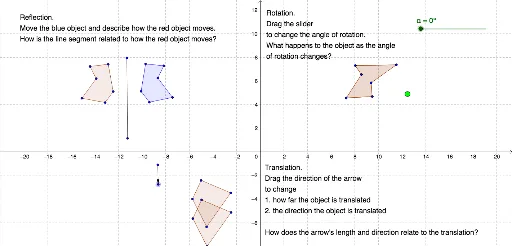
① This activity demonstrates how a polygon and its transformed copies (reflected, rotated, and translated) illustrate basic geometric transformations, making it ideal for lower-grade students to explore motion in geometry. ② Core math concepts include translation, rotation, reflection, and the invariant property that transformations preserve shape and size, along with polygons, segments, and vectors. ③ Construction highlights: using GeoGebra commands Polygon to create the original poly1, Segment for edges, Mirror to reflect poly1 into poly1', Rotate for rotation, Vector to define translation direction, and Translate to move the shape; objects include points A–F, segments a–f, transformed points A'–F', and poly1', showing the complete transformation process. ④ Suitable for grade 6 or early middle school geometry lessons, teacher demonstrations, or student self-exploration to grasp the fundamental idea that transformations do not alter a figure's shape or size.
GeoGebra Commands & Parameters
Polygon(A, B, C, D, E, F) → poly1, a, b, c, d, e, fSegment(G, H) → gPolygon(I, J, K, L, M, N) → poly2, i, j, k, l, m, nMirror(A, g) → A'Mirror(B, g) → B'Mirror(C, g) → C'Mirror(D, g) → D'Mirror(E, g) → E'Mirror(F, g) → F'Polygon(A', B', C', D', E', F') → poly1', a', b', c', d', e', f'Rotate(I, α, O) → I'Rotate(J, α, O) → J'Rotate(K, α, O) → K'Rotate(L, α, O) → L'Rotate(M, α, O) → M'Rotate(N, α, O) → N'Polygon(I', J', K', L', M', N') → poly2', i', j', k', l', m', n'Polygon(P, Q, R, S) → poly3, p, q, r, sVector(T, U) → uTranslate(P, u) → P'Translate(Q, u) → Q'Translate(R, u) → R'Translate(S, u) → S'Polygon(P', Q', R', S') → poly3', p', q', r', s'