
Proof Without Words by Steve Phelps (2)
Loading the math board and drawing, please wait…
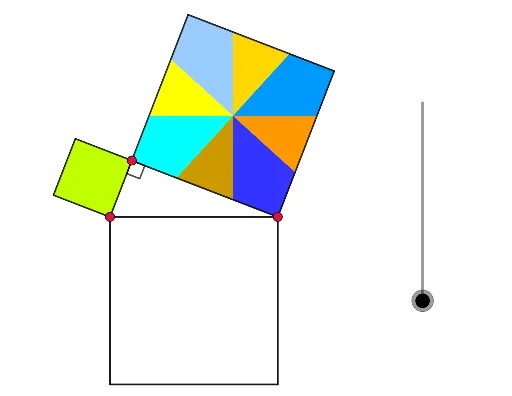
This example demonstrates the Pythagorean Theorem through dynamic geometry, visually showing the relationship between the area of a right triangle and the area of a semicircle on the hypotenuse. Key math concepts include area, Pythagorean Theorem, right triangle, semicircle. Construction involves commands like Point, Line, Polygon, Semicircle, Centroid, OrthogonalLine, Angle, Intersect, Midpoint, Mirror, If. Suitable for high school mathematics teaching to assist in understanding the geometric meaning and proof of the Pythagorean Theorem.
GeoGebra Commands & Parameters
Point(xAxis) → APoint(xAxis) → BLine(A, B) → tPolygon(B, A, 4) → poly3, n, p, q, r, H, ISemicircle(A, B) → cPoint(c) → CPolygon(C, B, 4) → poly2, j, k, l, m, F, GCentroid(poly2) → JOrthogonalLine(J, n) → sPolygon(A, C, 4) → poly1, f, g, h, i, D, ECentroid(poly3) → KCentroid(poly1) → LAngle(A, C, B) → αIntersect(s, j) → MIntersect(s, l) → NMidpoint(j) → OMirror(M, O) → M'Mirror(M', J) → M''OrthogonalLine(J, s) → aMidpoint(k) → PIntersect(a, k) → QMirror(Q, P) → Q'Mirror(Q, J) → Q'_1Mirror(Q', J) → Q''Polygon(J, M, B, Q') → q1, j_1, m_1, b, q'Polygon(J, Q, F, M'') → q2, j_2, q_1, f_1, m''Polygon(J, N, G, Q'') → q3, j_3, n_1, g_1, q''Polygon(J, Q'_1, C, M') → q4, j_4, q'_1, c_1, m'If(0 < o ≤ 1, Polygon[Translate[J, Vector[J, Dilate[J, 1 - o, A]]], Translate[M, Vector[J, Dilate[J, 1 - o, A]]], Translate[B, Vector[J, Dilate[J, 1 - o, A]]], Translate[Q', Vector[J, Dilate[J, 1 - o, A]]]], Polygon[Translate[J, A - J], Translate[M, A - J], Translate[B, A - J], Translate[Q', A - J]]) → q5If(2 < o ≤ 3, Polygon[Translate[J, Vector[J, Dilate[J, 3 - o, H]]], Translate[Q, Vector[J, Dilate[J, 3 - o, H]]], Translate[F, Vector[J, Dilate[J, 3 - o, H]]], Translate[M'', Vector[J, Dilate[J, 3 - o, H]]]], Polygon[Translate[J, H - J], Translate[Q, H - J], Translate[F, H - J], Translate[M'', H - J]]) → q6If(4 < o ≤ 5, Polygon[Translate[J, Vector[J, Dilate[J, 5 - o, I]]], Translate[N, Vector[J, Dilate[J, 5 - o, I]]], Translate[G, Vector[J, Dilate[J, 5 - o, I]]], Translate[Q'', Vector[J, Dilate[J, 5 - o, I]]]], Polygon[Translate[J, I - J], Translate[N, I - J], Translate[G, I - J], Translate[Q'', I - J]]) → q7If(6 < o ≤ 7, Polygon[Translate[J, Vector[J, Dilate[J, 7 - o, B]]], Translate[Q'_1, Vector[J, Dilate[J, 7 - o, B]]], Translate[C, Vector[J, Dilate[J, 7 - o, B]]], Translate[M', Vector[J, Dilate[J, 7 - o, B]]]], Polygon[Translate[J, B - J], Translate[Q'_1, B - J], Translate[C, B - J], Translate[M', B - J]]) → q8Polygon(J, M', M) → t1, m_2, j_5, dPolygon(J, Q', Q) → t2, q_2, j_6, ePolygon(J, M'', N) → t3, n_2, j_7, h_1Polygon(J, Q'', Q'_1) → t4, i_1, j_8, k_1If(8 < o ≤ 9, Polygon[Translate[J, Vector[J, Dilate[J, 9 - o, B]]], Translate[M', Vector[J, Dilate[J, 9 - o, B]]], Translate[M, Vector[J, Dilate[J, 9 - o, B]]]], Polygon[Translate[J, B - J], Translate[M', B - J], Translate[M, B - J]]) → t5If(10 < o ≤ 11, Polygon[Translate[J, Vector[J, Dilate[J, 11 - o, A]]], Translate[Q', Vector[J, Dilate[J, 11 - o, A]]], Translate[Q, Vector[J, Dilate[J, 11 - o, A]]]], Polygon[Translate[J, A - J], Translate[Q', A - J], Translate[Q, A - J]]) → t6If(12 < o ≤ 13, Polygon[Translate[J, Vector[J, Dilate[J, 13 - o, H]]], Translate[M'', Vector[J, Dilate[J, 13 - o, H]]], Translate[N, Vector[J, Dilate[J, 13 - o, H]]]], Polygon[Translate[J, H - J], Translate[M'', H - J], Translate[N, H - J]]) → t7If(14 < o ≤ 15, Polygon[Translate[J, Vector[J, Dilate[J, 15 - o, I]]], Translate[Q'', Vector[J, Dilate[J, 15 - o, I]]], Translate[Q'_1, Vector[J, Dilate[J, 15 - o, I]]]], Polygon[Translate[J, I - J], Translate[Q'', I - J], Translate[Q'_1, I - J]]) → t8Polygon(A, E, D, C) → q9, a_1, e_1, d_1, c_2If(16 < o ≤ 17, Polygon[Translate[A, Vector[L, Dilate[L, 17 - o, K]]], Translate[E, Vector[L, Dilate[L, 17 - o, K]]], Translate[D, Vector[L, Dilate[L, 17 - o, K]]], Translate[C, Vector[L, Dilate[L, 17 - o, K]]]], Polygon[Translate[A, K - L], Translate[E, K - L], Translate[D, K - L], Translate[C, K - L]]) → q10
AI Drawing Prompt Reference
Draw a right triangle with a semicircle on the hypotenuse to demonstrate the Pythagorean theorem. Start by plotting the vertices and edges of the right triangle, then draw the semicircle on the hypotenuse. Find the centroids of the triangle and semicircle, and draw perpendicular lines from the centroids to the triangle's legs. Use these lines and vertices to create multiple small triangles and quadrilaterals, showing the area relationship through dynamic transformations.
The prompt above was compiled from the original drawing commands and is for reference only.