
Proof of Sphere Volume Formula
Loading the math board and drawing, please wait…
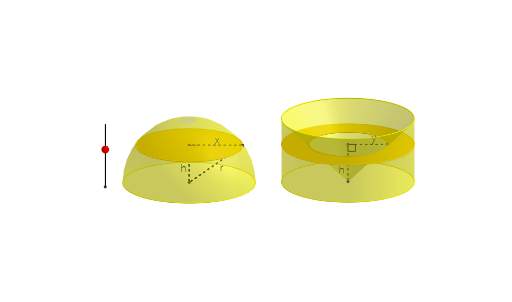
This GeoGebra example demonstrates the proof of the sphere volume formula V=4/3πr³. Core mathematical concepts include sphere volume, relationship between cylinder and cone volumes, and the Cavalieri principle (Zu Geng principle). Construction key points: Using GeoGebra commands like Sphere to create the sphere, Cylinder and Cone to build reference cylinder and cone, IntersectPath for intersection curves, Rotate for rotation operations, Surface to draw curved surfaces, Sequence to generate point sequences, and Polygon to construct polygon approximations. Suitable for high school upper grades and university calculus courses, ideal for teaching solid geometry volume concepts and as visual demonstration material for definite integral applications in calculus.
GeoGebra Commands & Parameters
Circle(A, 1) → cCircle(B, 1) → dPoint(c) → CSphere(A, C) → aCylinder(B, D, 1) → b, e, f, gCone(D, B, 1) → h, k, iSegment(E, E + (0, 0, 1)) → jPoint(j) → FOrthogonalPlane(F, j) → lIntersectPath(l, a) → pIntersectPath(l, h) → qIntersectPath(l, b) → rPoint(q) → HIntersect(Ray[G, H], r) → I,Rotate(H, α, G) → H'Rotate(I, α, G) → I'Polygon(H, H', I', I) → poly1, h_1, h', i', i_1Sequence(Rotate[poly1, (k * α), G], k, 0, n) → list1Intersect(Ray[J, J + (1, 0, 0)], p) → K,Segment(A, J) → sSegment(J, K) → tSegment(K, A) → a_1Intersect(Ray[G, G + (1, 0, 0)], q) → L, MSegment(B, G) → b_1Segment(G, L) → c_1Circle(s, C) → d_1Angle(A, J, K) → βAngle(B, G, L) → γCircle(B, 1, Segment[B, B + (0, 0, 1)]) → e_1Surface((sqrt(1 - h^(2)) * cos(θ)) + x(A), (sqrt(1 - h^(2)) * sin(θ)) + y(A), h, θ, 0, 6.28319, h, 0, 1) → o
AI Drawing Prompt Reference
Draw a diagram proving the sphere volume formula. Start with two circles of radius one. Pick a point on one circle to define the sphere's radius. Construct a sphere, a cylinder, and a cone with the same height, placing the cone inside the cylinder. Use horizontal planes to slice the sphere, cone, and cylinder, creating circular cross-sections. On a cross-section, take a point and rotate it around the vertical axis to generate a series of thin polygon slices, illustrating integration. Finally, outline the sphere, cylinder, and cone, and mark relevant angles and radii. The diagram shows that the sphere's volume equals the cylinder's volume minus the cone's volume.
The prompt above was compiled from the original drawing commands and is for reference only.