
Ponzi Game Geometric Demonstration
Loading the math board and drawing, please wait…
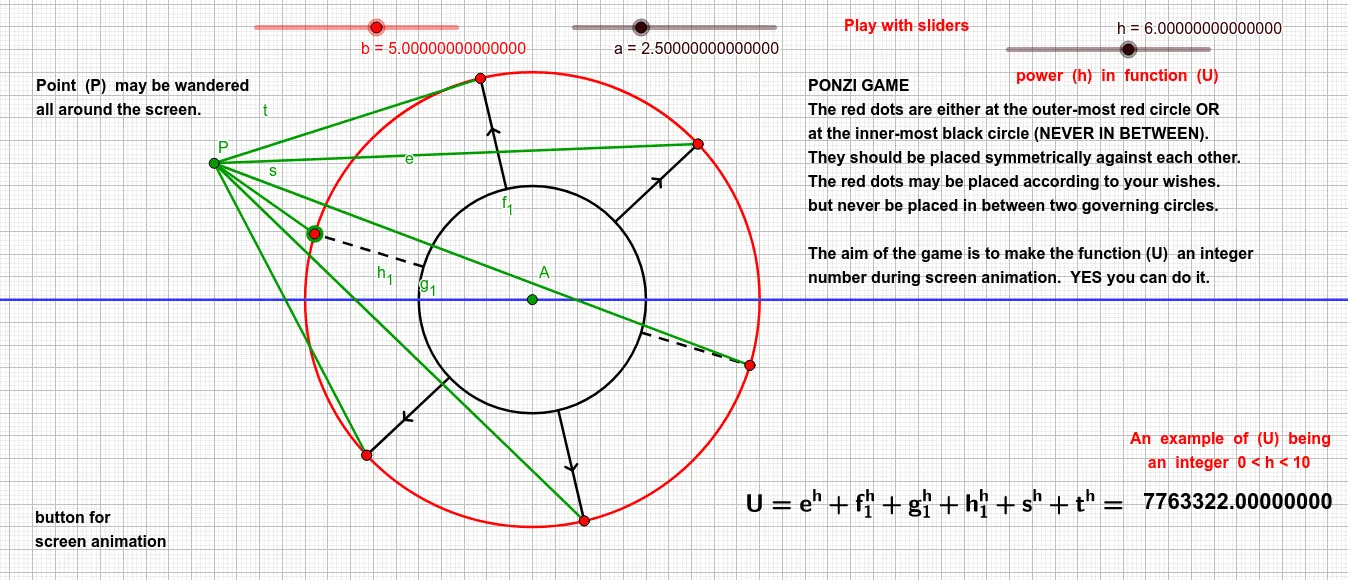
This example dynamically demonstrates the geometric relationships in a Ponzi game, revealing its underlying mathematical principles. It involves core concepts like circles, geometric transformations, similarity transformations, probability distributions, and integral sums. The construction utilizes GeoGebra commands such as Circle, Point, Segment, Intersect, Rotate, Angle, and Line. Suitable for high school and above learners to understand the integration of geometric transformations and probability statistics.
GeoGebra Commands & Parameters
Circle(A, a) → cCircle(A, b) → dPoint(d) → BSegment(B, A) → fIntersect(c, f, 1) → DSegment(D, B) → mPoint(m) → KRotate(B, 60°, A) → B'Segment(B', A) → gIntersect(c, g, 1) → ESegment(E, B') → lPoint(l) → JRotate(B', 60°, A) → B''Segment(A, B'') → h_2Intersect(c, h_2, 1) → FSegment(F, B'') → rPoint(r) → LRotate(B'', 60°, A) → B'''Segment(A, B''') → iIntersect(c, i, 1) → GSegment(G, B''') → qPoint(q) → MRotate(B''', 60°, A) → CSegment(A, C) → jIntersect(c, j, 1) → HSegment(H, C) → pPoint(p) → NRotate(C, 60°, A) → C'Segment(A, C') → kIntersect(c, k, 1) → ISegment(I, C') → nPoint(n) → OSegment(K, P) → sSegment(J, P) → h_1Segment(L, P) → g_1Segment(M, P) → f_1Segment(N, P) → eSegment(O, P) → tAngle(B, A, B') → αAngle(B', A, B'') → βAngle(B'', A, B''') → γAngle(B''', A, C) → δAngle(C, A, C') → εLine(Q, R) → i_1