
Polygon Angle Theorems: Triangle to Octagon
Loading the math board and drawing, please wait…
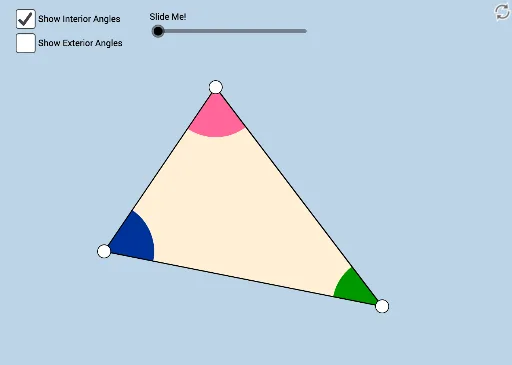
This example dynamically illustrates the interior and exterior angle theorems for polygons from triangles to octagons. By adjusting the number of sides, you can observe the changes in interior and exterior angles. Key mathematical concepts include the interior and exterior angle theorems for polygons. The construction uses GeoGebra commands such as Segment, Polygon, Circle, Angle, etc. Suitable for middle school and above students to learn polygon geometry.
GeoGebra Commands & Parameters
Segment(B, C) → eSegment(C, A) → fMin(f, e) → mSegment(A, B) → dMin(d, f) → oMin(m, o) → uPolygon(A, B, C) → poly1, c, a, bRay(A, B) → hRay(B, C) → iRay(C, A) → jCircle(C, (0.25 * u)) → pCircle(A, (0.25 * u)) → qCircle(B, (0.25 * u)) → rIntersect(p, f) → D,Intersect(p, e, 1) → EIntersect(r, e, 1) → FIntersect(r, d, 1) → GIntersect(q, d, 1) → HIntersect(q, f, 1) → IIntersect(r, h, 2) → JIntersect(q, j, 2) → KIntersect(p, i, 2) → LMidpoint(f) → MMidpoint(e) → NCircleSector(A, H, I) → sCircleSector(B, F, G) → tCircleSector(C, D, E) → c_1Angle(A, C, B) → αCircleSector(C, E, D) → d_1CircleSector(A, I, H) → e_1CircleSector(B, G, F) → f_1Min(d, e) → nRotate(s, If[0 < l ≤ 1, (((-l) * 180))°, -180°], M) → s'Rotate(A, If[0 < l ≤ 1, (((-l) * 180))°, -180°], M) → A'Segment(M, A') → a_1Rotate(H, -180°, M) → H'Line(H', C) → b_1Rotate(B, If[0 < l ≤ 1, ((l * 180))°, 180°], N) → B'Rotate(t, If[0 < l ≤ 1, ((l * 180))°, 180°], N) → t'Segment(N, B') → g_1Segment(C, M) → h_1Segment(M, A) → i_1Segment(C, N) → j_1Segment(N, B) → k_1Rotate(A, If[0 < l ≤ 1, ((l * 180))°, -180°], M) → A'_1Rotate(B, If[0 < l ≤ 1, (((-l) * 180))°, -180°], N) → B'_1Segment(N, B'_1) → l_1Segment(M, A'_1) → m_1Rotate(e_1, If[0 < l ≤ 1, ((l * 180))°, -180°], M) → p_1Rotate(f_1, If[0 < l ≤ 1, (((-l) * 180))°, -180°], N) → q_1CircleSector(C, L, D) → r_1CircleSector(A, K, H) → s_1CircleSector(B, J, F) → t_1CircleSector(A, H, K) → c_2CircleSector(B, F, J) → d_2CircleSector(C, D, L) → e_2Dilate(A, 1 - v, C) → A'_2Dilate(B, 1 - v, C) → B'_2Vector(A, A'_2) → wVector(B, B'_2) → u_1Translate(s_1, w) → f_2CircleArc(A, K, H) → g_2Translate(t_1, u_1) → h_2CircleArc(B, J, F) → k_2Translate(c_2, w) → p_2CircleArc(A, H, K) → q_2Translate(d_2, u_1) → r_2CircleArc(B, F, J) → s_2
AI Drawing Prompt Reference
Draw a polygon to illustrate the interior and exterior angle theorems, starting from a triangle and increasing to an octagon. Dynamically adjust the number of sides to observe changes in interior and exterior angles. Use circles and sectors to represent angles, connecting key points with lines to form the polygon's parts. Begin with the basic polygon, add rays and circles, and finally use sectors and lines to mark angles for clarity.
The prompt above was compiled from the original drawing commands and is for reference only.