
Pole Task: Finding Height of Point P
Loading the math board and drawing, please wait…
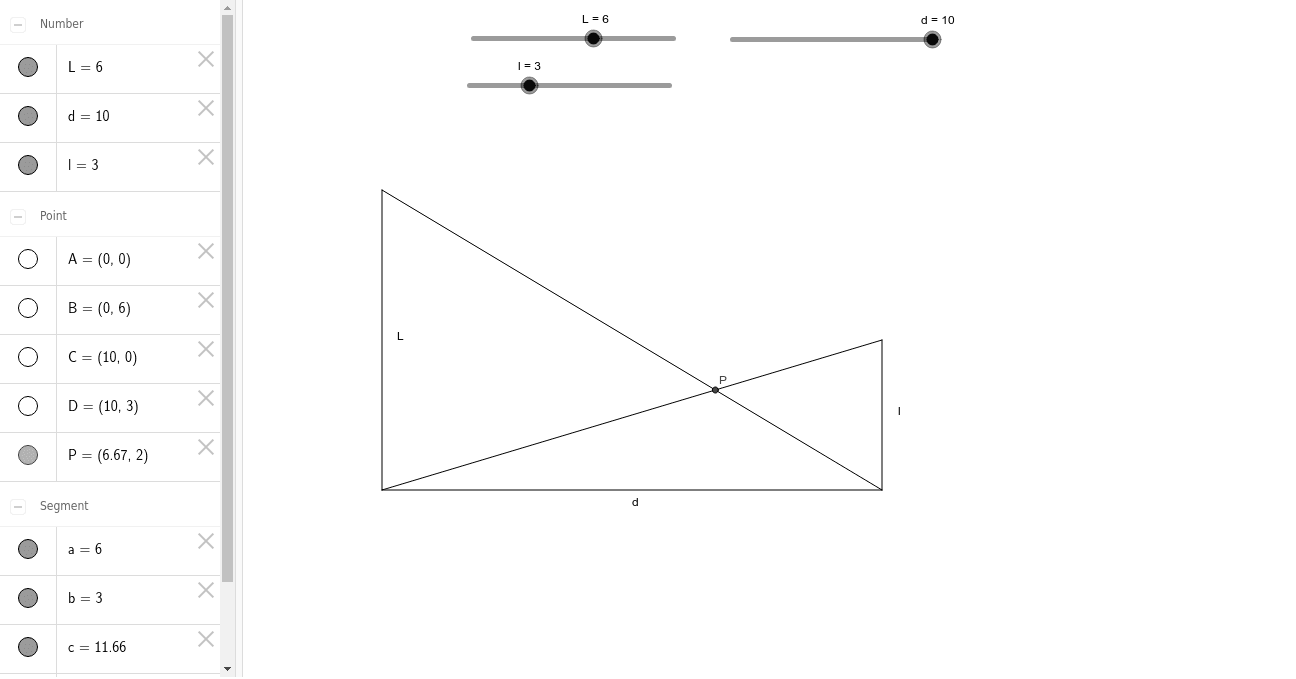
This example demonstrates solving a spatial geometry problem by applying the principle of similar triangles to find the height of point P. Key math concepts include similar triangles, triangle properties, cube geometry, intersection calculations, quadrilateral construction, and derivative applications. The construction uses GeoGebra commands like Segment and Intersect to create objects A, L, B, d, l, C, D, a, b, c, e, P, f. It is suitable for high school and above students to understand the integration of spatial geometry and calculus, enhancing geometric construction and reasoning skills.
GeoGebra Commands & Parameters
Segment(A, B) → aSegment(C, D) → bSegment(B, C) → cSegment(A, D) → eIntersect(c, e) → PSegment(A, C) → f
AI Drawing Prompt Reference
Draw a geometric figure using similar triangles to illustrate the height of point P. The figure includes points A, B, C, D, P and segments a, b, c, e, f. The construction order is to draw segments a, b, c, e first, then find their intersection point P, and finally draw segment f. This figure helps understand geometric principles and triangle applications.
The prompt above was compiled from the original drawing commands and is for reference only.