
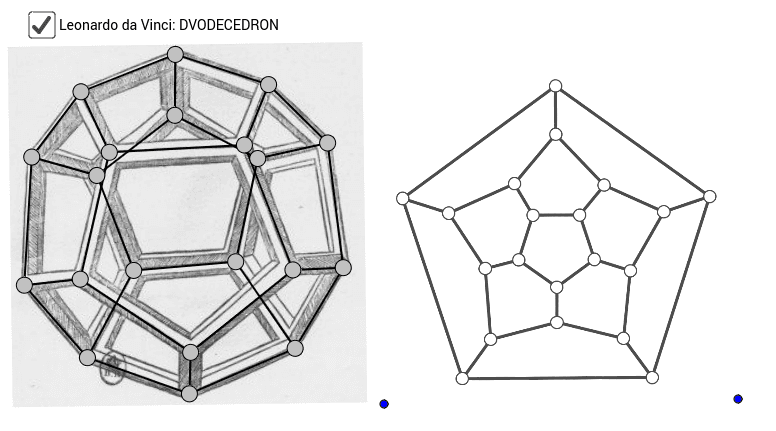
Planar Graph of a Dodecahedron
Loading the math board and drawing, please wait…
This example demonstrates the planar graph of a dodecahedron, showing how the 3D solid can be represented in a 2D plane. Key math concepts include polygons, vertex connections, and geometric construction. The construction uses commands like Segment and multiple objects such as G, H, A, B, etc. It is suitable for high school mathematics or geometry courses to teach the structure and planar representation of a dodecahedron.
GeoGebra Commands & Parameters
Segment(G, H) → aSegment(E, G) → bSegment(E, F) → cSegment(F, I) → dSegment(I, H) → eSegment(F, L) → fSegment(J, I) → gSegment(L, M) → hSegment(M, N) → iSegment(N, E) → jSegment(T, M) → kSegment(T, S) → lSegment(S, O) → mSegment(O, P) → nSegment(P, G) → pSegment(Q, P) → qSegment(Q, R) → rSegment(S, W) → sSegment(W, Q) → tSegment(R, Z) → a_1Segment(Z, V) → b_1Segment(V, W) → c_1Segment(U, V) → d_1Segment(U, T) → e_1Segment(U, K) → f_1Segment(K, J) → g_1Segment(Z, J) → h_1Segment(K, L) → i_1Segment(R, H) → j_1Segment(O, N) → k_1
AI Drawing Prompt Reference
Draw a planar graph of a dodecahedron, showing how the 3D solid can be represented in a 2D plane. Connect various points with line segments to form the vertices and edges of the pentagon, then build a network structure by connecting these vertices, resulting in a clear planar graph suitable for geometry lessons.
The prompt above was compiled from the original drawing commands and is for reference only.