
Piscis Austrinus: A Composite Polyhedral and Geometric Transformation Figure
Loading the math board and drawing, please wait…
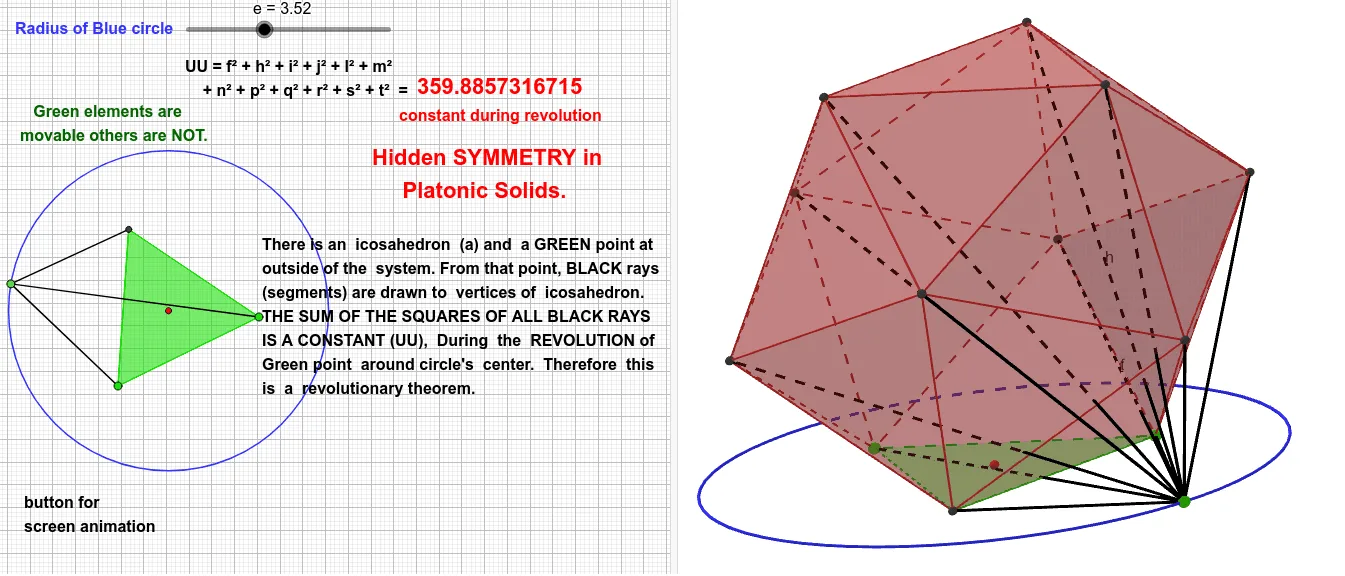
This example demonstrates a complex 3D geometric figure constructed from an icosahedron, its vertices, edges, face centers, and additional circles and polygons, visually resembling the constellation 'Piscis Austrinus'. Core mathematical concepts include solid geometry (regular icosahedron), centroid/barycenter, circumscribed circles, general quadrilaterals, symmetry, geometric transformations, and matrix operations. Construction highlights: using GeoGebra commands such as Polygon, Icosahedron, Midpoint, Centroid, Circle, Point, and Segment, the figure builds multiple faces (e.g., faceACF, faceAFG) and edges (edgeAF) with text labels. Suitable for high school and above students or educators to explore polyhedral structures, transformations, and symmetry, and also useful for mathematical art or interdisciplinary projects.
GeoGebra Commands & Parameters
Polygon(A, B, 3) → poly1, f_2, g, h_2, CIcosahedron(poly1, true) → a, D, faceACF, faceAFG, faceADG, faceABD, faceBDH, faceBEH, faceBCE, faceCEI, faceCFI, faceEHK, E, faceEIK, faceIKL, faceFIL, faceHJK, faceJKL, faceGJL, faceFGL, faceDHJ, faceDGJ, edgeAF, F, edgeCF, edgeAG, edgeFG, edgeAD, edgeDG, edgeBD, edgeBH, edgeDH, edgeBE, edgeEH, G, edgeCE, edgeCI, edgeEI, edgeFI, edgeEK, edgeHK, edgeIK, edgeIL, edgeKL, edgeFL, H, edgeJK, edgeHJ, edgeJL, edgeGL, edgeGJ, edgeDJ, I, J, K, LPolygon(A, B, C) → t1, c, a_1, bPolygon(G, D, A) → t2, a_2, g_1, dMidpoint(A, C) → OMidpoint(A, B) → PMidpoint(C, B) → QMidpoint(A, D) → RMidpoint(G, D) → SMidpoint(G, A) → TCentroid(poly1) → MCircle(M, e) → kPoint(k) → NSegment(I, N) → iSegment(C, N) → jSegment(F, N) → lSegment(L, N) → mSegment(E, N) → nSegment(B, N) → pSegment(N, A) → qSegment(G, N) → rSegment(K, N) → sSegment(H, N) → tSegment(D, N) → fSegment(J, N) → h
AI Drawing Prompt Reference
Create a complex 3D geometric figure based on a regular icosahedron. Start with an equilateral triangle as the base face, then generate the full icosahedron showing all vertices, edges, and triangular faces. Construct another triangle on the base vertices, and take midpoints of several edges to form inner polygons. Find the centroid of the base triangle, draw a circle centered there passing through a vertex, and place a point on this circle. From that point, draw line segments to many vertices of the icosahedron, creating a radial web. The overall shape is symmetric, layered, and resembles a constellation.
The prompt above was compiled from the original drawing commands and is for reference only.