
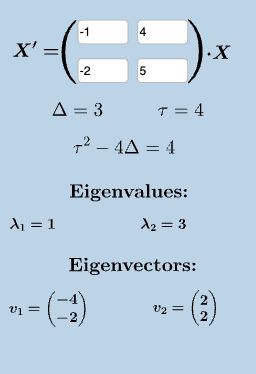
Phase portrait of homogeneous linear first-order system DE
Loading the math board and drawing, please wait…
This example demonstrates the phase portrait of a homogeneous linear first-order system of differential equations. Key mathematical concepts involved include differential equations, linear equations, logarithmic functions, similar triangles, frequency distribution, and right triangles. The construction utilizes GeoGebra commands and objects such as Identity, Element, If, Textfield, UnitVector, Line, SurdText, Locus, Sequence, Point, Segment, Mirror, Determinant, and LaTeX. It is suitable for university-level mathematics students or learners seeking a graphical understanding of differential equations.
GeoGebra Commands & Parameters
Identity(2) → IElement(eigenvalues, 2) → λ2Element(eigenvalues, 1) → λ1If(c ≠ 0 ∨ a - λ1 ≠ 0, Vector[((sgn(a - λ1) * (a - λ1)), (sgn(a - λ1) * c))], Vector[If[b ≠ 0 ∨ d - λ1 ≠ 0, Vector[((sgn(b) * b), (sgn(b) * (d - λ1)))], Vector[(1, 0)]]]) → Ev2If(c ≟ 0 ∧ b ≟ 0 ∧ a > d, Vector[(1, 0)], Vector[If[c ≟ 0 ∧ b ≟ 0 ∧ a ≤ d, Vector[(1, 0)]]]) → w2If(c ≟ 0 ∧ b ≟ 0 ∧ a > d, Vector[(0, 1)], Vector[If[c ≟ 0 ∧ b ≟ 0 ∧ a ≤ d, Vector[(0, 1)]]]) → w1Textfield(a) → InputBox1Textfield(b) → InputBox2Textfield(c) → InputBox3Textfield(d) → InputBox4If(a^(2) + ((4 * b) * c) - ((2 * a) * d) + d^(2) > 0, 2, If[a^(2) + ((4 * b) * c) - ((2 * a) * d) + d^(2) < 0, 0, 1]) → numEigenvaluesUnitVector(Vector[If[eive2 ≟ eive2, eive2, Vector[If[w2 ≟ w2, w2, Ev2]]]]) → e2UnitVector(Vector[If[eive1 ≟ eive1, eive1, Vector[If[numEigenvalues ≟ 1, Ev2, Vector[If[w1 ≟ w1, w1, Ev1]]]]]]) → e1Line((0, 0), e1) → hLine((0, 0), e2) → iSurdText(x(e1)) → text8SurdText(y(e1)) → text9SurdText(x(e2)) → text10SurdText(y(e2)) → text11SurdText(λ1) → text14SurdText(λ2) → text15Locus(g(x, y) / f(x, y), A) → numericalIntegral1Sequence((x(Element[ListP, i]) + (0.001 * f(x(Element[ListP, i]), y(Element[ListP, i]))), y(Element[ListP, i]) + (0.001 * g(x(Element[ListP, i]), y(Element[ListP, i])))), i, 1, 8) → ListP1Sequence(Segment[Element[ListP, i], Element[ListP1, i]], i, 1, 8) → SegmentListElement(SegmentList, 1) → Segment1Element(SegmentList, 2) → Segment2Element(SegmentList, 3) → Segment3Element(SegmentList, 4) → Segment4Element(SegmentList, 5) → Segment5Element(SegmentList, 6) → Segment6Element(SegmentList, 7) → Segment7Sequence(Locus[g(x, y) / f(x, y), Element[ListP, i]], i, 1, 8) → list1Element(SegmentList, 8) → Segment8Point(h) → NPoint(i) → OSegment(N, N1) → Segment9Segment(O, O1) → Segment10Mirror(N, (0, 0)) → N'Mirror(N1, (0, 0)) → N1'Segment(N', N1') → Segment9'Mirror(O, (0, 0)) → O'Mirror(O1, (0, 0)) → O1'Segment(O', O1') → Segment10'Determinant(T) → DeterminantTextfield(a) → InputBox1_1Textfield(b) → InputBox2_1Textfield(c) → InputBox3_1Textfield(d) → InputBox4_1Determinant(T_1) → Determinant_1If(eive2 ≟ eive2, eive2, Vector[If[w2 ≟ w2, w2, Ev2]]) → e22If(eive1 ≟ eive1, eive1, Vector[If[numEigenvalues ≟ 1, Ev2, Vector[If[w1 ≟ w1, w1, Ev1]]]]) → e11Element(CEigenvalues, 1) → cλ1Element(CEigenvalues, 2) → cλ2Identity(2) → I_1Element(eigenvalues_1, 1) → λ1_1Textfield(a) → InputBox1_2Textfield(b) → InputBox2_2Textfield(c) → InputBox3_2Textfield(d) → InputBox4_2SurdText(λ1_1) → text14_1Determinant(T_2) → Determinant_2Textfield(a) → InputBox1_3Textfield(b) → InputBox2_3Textfield(c) → InputBox3_3Textfield(d) → InputBox4_3LaTeX(CEigenvalues) → text16