
Perimeter Demo: Circumference, Square, and Arbitrary Triangle
Loading the math board and drawing, please wait…
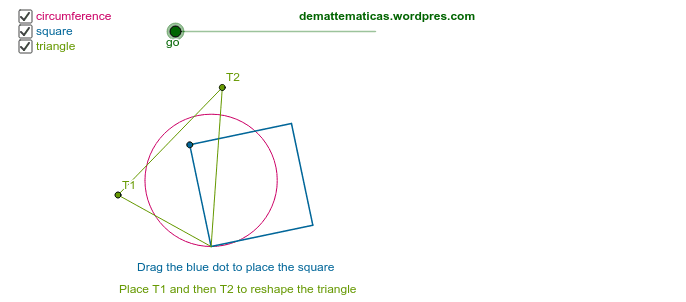
① This interactive GeoGebra applet visually demonstrates the concept of perimeter by displaying and comparing the perimeters of a circle (circumference), a square, and an arbitrary triangle. ② Core mathematical concepts include the definition of perimeter, the circumference formula (2πr), square perimeter (4a), triangle perimeter as sum of three sides, with connections to the Pythagorean theorem for side length calculations and linear regression for possible data fitting. ③ Construction highlights: Based on the construction summary, the applet uses GeoGebra commands such as Segment, Circle, CircleSector, CircleArc, Distance, Angle, Rotate, Intersect, OrthogonalLine, Line, and Ray. It defines multiple objects including points (A, B, M, N, J, K), segments (a, b, d_1, lsquare, ltriangle1/2), circles (c_1, e_1), and parameter objects (triangleparam, sumtriangle, phasesquare, go) to enable dynamic step-by-step visualization via sliders. ④ Suitable for upper elementary to middle school students learning basic geometry, and for teachers to illustrate perimeter formulas and comparisons in an interactive classroom setting.
GeoGebra Commands & Parameters
Segment(A, B) → aOrthogonalLine(A, a) → bDistance(A, B) → PmtCircle(A, Pmt / 2) → d_1Intersect(d_1, b, 2) → LRotate(L, 89°, A) → L'CircleSector(A, L, L') → e_1PointIn(e_1) → T1Distance(A, T1) → ltriangle2Circle(A, ltriangle2) → p_1Intersect(p_1, a, 1) → NAngle(N, A, T1) → RT1Ellipse(A, T1, triangleparam / 2) → f_1Point(f_1) → T2If(alphatrianglestart ≟ (Angle[B, A, T2] * 360 / 2 / π), 1, 2) → casetriangleIf(go < alphatrianglestart / sumtriangle, 1, If[go < (alphatrianglestart + 180 - angleT2) / sumtriangle, 2, 3]) → phasetriangle1If(casetriangle ≟ 2 ∧ phasetriangle1 ≟ 1, RT1 - ((go / alphatrianglestart * sumtriangle) * RT1)) → alpha2triangle1Distance(T2, A) → ltriangle1Circle(A, ltriangle1) → k_1Intersect(k_1, a, 1) → MAngle(M, A, T2) → RT2If(casetriangle ≟ 1 ∧ phasetriangle1 ≟ 1, RT2 - ((go / alphatrianglestart * sumtriangle) * RT2)) → alpha1triangle1Circle(A, lsquare) → gIntersect(g, b, 2) → JRotate(J, 89°, A) → J'CircleArc(A, J, J') → c_1Point(c_1) → KAngle(J, A, K) → alphasquarestartIf(go < alphasquarestart / sum, 1, If[go < (alphasquarestart + 90°) / sum, 2, If[go < (alphasquarestart + 180°) / sum, 3, 4]]) → phasesquareIntersect(g, a, 1) → HCircle(H, lsquare) → cIf(phasesquare ≟ 1, 90° + (alphasquarestart * (1 - (go * sum / alphasquarestart)))) → alphasquare1Intersect(c, a, 1) → ILine(D, b) → eDistance(A, D) → parcCircle(A, rcircle) → ccircleIntersect(ccircle, b, 2) → CLine(C, a) → fIntersect(e, f) → ERotate(D, alphacircle, E) → D'Angle(D, E, D') → αCircleArc(E, D, D') → gcircleSegment(A, D) → hcircleRotate(H, alphasquare1, A) → GRotate(G, -90°, A) → G'Rotate(A, 90°, G) → F'Segment(F', G') → iSegment(F', G) → jSegment(G, A) → dSegment(A, G') → hIf(phasesquare ≟ 2, 90° + ((90 * (1 - ((go - alphasquarestart / sum) * sum / (90°)))))°) → alphasquare2Rotate(I, alphasquare2, H) → I'Angle(I, H, I') → βRotate(H, 90°, I') → H'Angle(H, I', H') → γRotate(I', 90°, H') → I''Angle(I', H', I'') → δSegment(I', H') → kSegment(H', I'') → lSegment(I'', H) → mSegment(H, A) → nCircle(I, lsquare) → pIntersect(p, a, 2) → FIf(phasesquare ≟ 3, ((90 * (1 - ((go - (alphasquarestart + 90°) / sum) * sum / (90°)))))°) → alphasquare3Rotate(F, alphasquare3, I) → F'_1Angle(F, I, F'_1) → εRotate(I, -90°, F'_1) → I'_1Angle(I'_1, F'_1, I) → ζSegment(I'_1, F'_1) → qSegment(F'_1, I) → rIf(phasesquare ≟ 4, ((90 * (1 - ((go - (alphasquarestart + 180°) / sum) * sum / (90°)))))°) → alphasquare4Rotate(B, alphasquare4, F) → B'Angle(B, F, B') → ηSegment(B', F) → sSegment(H, I) → tSegment(I, F) → a_1Angle(J, A, J') → θAngle(L, A, L') → ιDistance(T1, T2) → ltriangleARotate(M, alpha1triangle1, A) → M'Angle(M, A, M') → κRotate(N, alpha2triangle1, A) → N'Angle(N, A, N') → λIf(go < alphatrianglestart / sumtriangle, 1, If[go < (alphatrianglestart + 180 - angleT1) / sumtriangle, 2, 3]) → phasetriangle2Segment(M', A) → h_1Circle(M', ltriangleA) → q_1Ray(M', A) → i_1Intersect(q_1, i_1, 1) → ORotate(O, (-(angleT2°)), M') → O'Angle(O', M', O) → μSegment(O', M') → j_1Segment(O', A) → l_1Segment(N', A) → b_1Circle(N', ltriangleA) → g_1Ray(N', A) → m_1Intersect(g_1, m_1, 1) → PRotate(P, (-(angleT1°)), N') → P'Angle(P', N', P) → νSegment(N', P') → n_1Segment(P', A) → r_1Circle(M, ltriangleA) → s_1Intersect(s_1, a, 1) → QIf(casetriangle ≟ 1 ∧ phasetriangle1 ≟ 2, (((180 - angleT2) * (1 - ((go - alphatrianglestart / sumtriangle) / (180 - angleT2) * sumtriangle))))°) → alpha1triangle2Rotate(Q, alpha1triangle2, M) → Q'Angle(Q, M, Q') → ξSegment(Q', M) → t_1Circle(Q', ltriangle2) → c_2Ray(Q', M) → a_2Intersect(c_2, a_2, 1) → RRotate(R, (-(angleT1°)), Q') → R'Angle(R', Q', R) → οSegment(Q', R') → b_2If(casetriangle ≟ 1 ∧ phasetriangle1 ≟ 3, (((180 - angleT1) * (1 - ((go - (alphatrianglestart + 180 - angleT2) / sumtriangle) / (180 - angleT1) * sumtriangle))))°) → alpha1triangle3Rotate(B, alpha1triangle3, Q) → B'_1Angle(B, Q, B'_1) → ρSegment(B'_1, Q) → e_2If(casetriangle ≟ 2 ∧ phasetriangle2 ≟ 2, (((180 - angleT1) * (1 - ((go - alphatrianglestart / sumtriangle) / (180 - angleT1) * sumtriangle))))°) → alpha2triangle2Circle(N, ltriangleA) → d_2Intersect(d_2, a, 2) → SRotate(S, alpha2triangle2, N) → S'Angle(S, N, S') → σCircle(S', ltriangle1) → f_2Ray(S', N) → g_2Intersect(f_2, g_2, 1) → TRotate(T, (-(angleT2°)), S') → T'Angle(T', S', T) → τSegment(S', T') → h_2Segment(N, S') → i_2Circle(S, ltriangle1) → k_2If(casetriangle ≟ 2 ∧ phasetriangle2 ≟ 3, (((180 - angleT2) * (1 - ((go - (alphatrianglestart + 180 - angleT1) / sumtriangle) / (180 - angleT2) * sumtriangle))))°) → alpha2triangle3Rotate(B, alpha2triangle3, S) → B'_2Angle(B, S, B'_2) → υSegment(B'_2, S) → j_2Segment(A, M) → l_2Segment(M, Q) → m_2Segment(A, N) → n_2Segment(N, S) → p_2
AI Drawing Prompt Reference
Create a diagram comparing the perimeters of a circle, a square, and an arbitrary triangle. Start with a horizontal base segment, use it as the radius to draw a circle, and place a point on the circle to form a sector, illustrating the circumference. Then construct a square by rotating a point and finding intersections, showing its side length and perimeter. Finally, construct an arbitrary triangle using an ellipse and angle parameters to adjust its shape, and compute the sum of its three sides. All shapes share a common center, with sliders controlling the expansion of each shape to visually compare their perimeters.
The prompt above was compiled from the original drawing commands and is for reference only.