
Geometrical Representation of Trigonometric Ratios
Loading the math board and drawing, please wait…
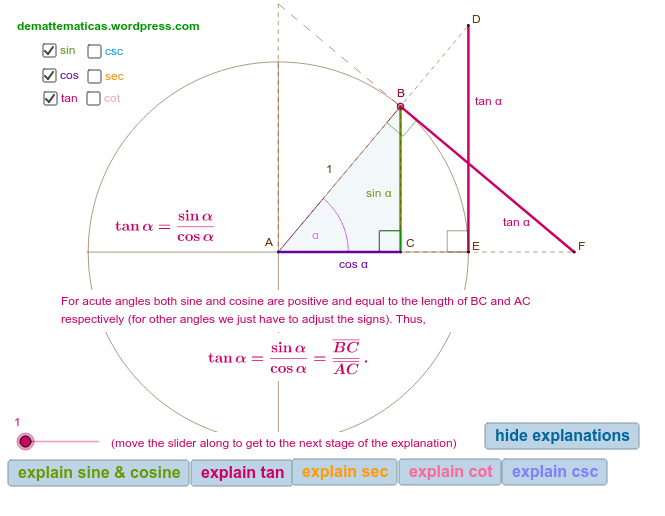
This applet demonstrates two well-known geometrical representations of trigonometric ratios. By dragging point B to set the angle, you can observe the changes in sine, cosine, tangent, etc. The applet involves concepts such as trigonometry and the unit circle, and uses commands like Circle, Line, Angle in GeoGebra. Suitable for students at the middle school level and above to learn basic trigonometric concepts.
GeoGebra Commands & Parameters
Circle(A, 1) → cLine(A, B) → aOrthogonalLine(A, a) → bPoint(b) → CPoint(b) → DSegment(C, D) → dPoint(a) → ESegment(E, B) → ePoint(c) → FSegment(A, F) → fIntersect(c, e, 2) → GOrthogonalLine(G, e) → gLine(A, F) → hIntersect(g, h) → HIntersect(c, d, 1) → IOrthogonalLine(I, d) → iOrthogonalLine(F, e) → jIntersect(j, e) → JSegment(F, J) → kSegment(A, J) → lSegment(H, G) → mTangent(F, c) → n,Intersect(a, n) → KSegment(F, K) → pSegment(A, K) → qSegment(A, H) → rIntersect(h, i) → LSegment(I, L) → sIntersect(b, n) → MSegment(M, F) → tSegment(A, L) → a_1Segment(M, A) → b_1Angle(G, A, F) → αSegment(F, J) → c_1Segment(F, K) → d_1Segment(G, H) → e_1Angle(A, F, K) → βSegment(A, H) → f_1Segment(A, K) → g_1Segment(A, L) → h_1Segment(M, A) → i_1Segment(A, L) → j_1Segment(A, J) → k_1Angle(K, F, A) → γSegment(M, F) → l_1Segment(I, L) → m_1Polygon(A, F, K) → polígono1, k_2, a_2, f_2Polygon(A, G, H) → polígono2, h_2, a_3, g_2Rotate(G, 50*°, A) → G'Polygon(A, J, F) → polígono3, f_3, a_4, j_2Polygon(A, F, K) → polígono4, k_3, a_5, f_4Polygon(A, G, H) → polígono5, h_3, a_6, g_3OrthogonalLine(F, d) → n_1Intersect(n_1, d) → NSegment(N, F) → p_1Segment(N, A) → q_1Angle(F, A, M) → δPolygon(A, N, F) → polígono6, f_5, a_7, n_2Segment(F, J) → r_1Segment(A, J) → s_1Polygon(L, I, A) → polígono7, a_8, l_2, i_2Polygon(M, F, A) → polígono8, a_9, m_2, f_6Angle(F, J, A) → εAngle(A, J, F) → ζAngle(H, G, A) → ηAngle(A, G, H) → θ
AI Drawing Prompt Reference
Draw a unit circle, create a line through points A and B, construct points C, D, E, F, G, H, I, J, K, L, M, N, O, P, Q, R, S, T, and connect them to form triangles and quadrilaterals, illustrating the geometric representations of sine, cosine, and tangent.
The prompt above was compiled from the original drawing commands and is for reference only.