
Parkland Puzzle 3: Geometric Application of Logic and Calculus
Loading the math board and drawing, please wait…
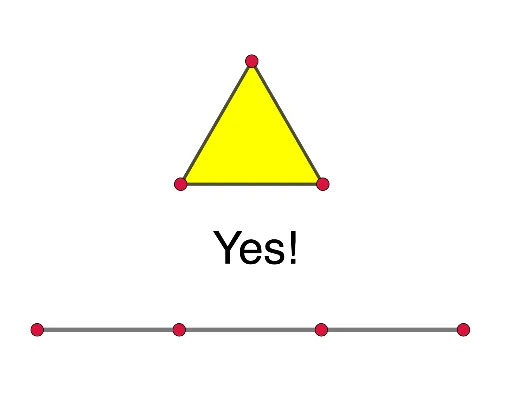
This example dynamically demonstrates the application of logical operations and calculus concepts in geometric constructions. It involves core math concepts like logic, differential calculus, unit circle, real numbers, functions, and rational numbers. Construction highlights include commands like Segment, Point, Min, Max, If, Midpoint, Circle, Intersect, and Polygon from GeoGebra, suitable for high school and above to understand the integration of complex geometric constructions with calculus principles.
GeoGebra Commands & Parameters
Segment((0, 0), (3, 0)) → fPoint(f) → CPoint(f) → DMin(x(C), x(D)) → aMax(x(C), x(D)) → bIf(s1 + s2 > s3 ∧ s2 + s3 > s1 ∧ s3 + s1 > s2, "Yes!", "No!") → text1Midpoint((0, 0), (a, 0)) → EMidpoint((b, 0), (a, 0)) → FMidpoint((b, 0), (3, 0)) → GCircle(H, s1) → cCircle(I, s3) → dIntersect(c, d, 1) → JPolygon(J, H, I) → t1, i, j, h
AI Drawing Prompt Reference
Draw a right triangle with one vertex at the origin and the base on the x-axis, length 3. Find the midpoints E, F, and G of the base. Draw a circle c centered at E with radius half the base length, and a circle d centered at G with radius equal to the hypotenuse. Find the intersection J of the two circles. Connect J, H, and I to form a triangle.
The prompt above was compiled from the original drawing commands and is for reference only.