
Parallels and Transversal: Angle Relationships
Loading the math board and drawing, please wait…
In collections
CLASS IX CBSE MATHS ACTIVITIES
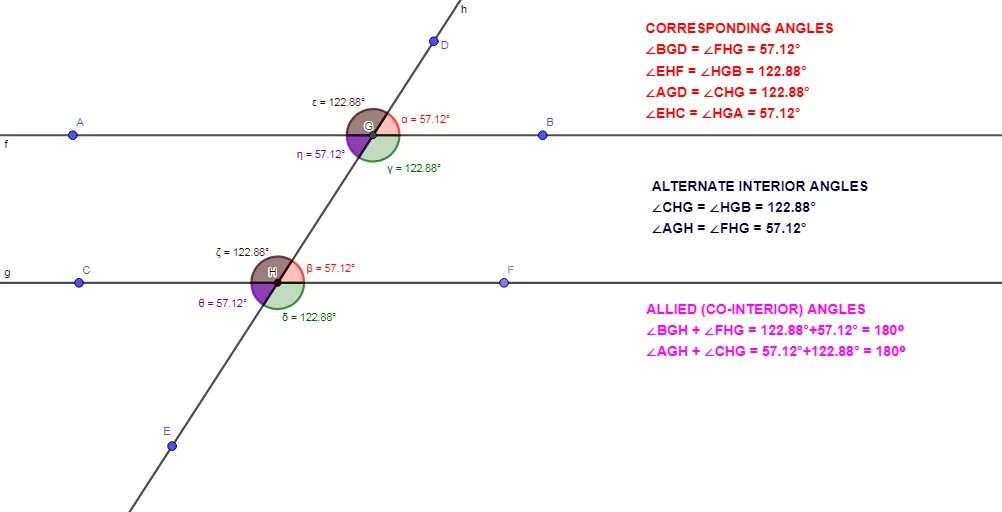
① This GeoGebra example dynamically demonstrates the relationships among corresponding angles, alternate interior angles, and consecutive interior angles formed when a transversal intersects two parallel lines. ② Core mathematical concepts include parallel lines, transversals, corresponding angles, alternate interior angles, consecutive interior angles, and angle equality/supplementarity. ③ Construction details: The Line command creates parallel lines f and transversal g; Point and Intersect commands define intersection points A, B, C, D, E, F, G, H; Angle command labels angles α, β, γ, δ, ε, ζ, η, θ; text1, text2, text3 provide explanatory annotations. ④ Suitable for middle school geometry lessons or self-study, helping learners visualize and verify angle relationships in parallel-line configurations.
GeoGebra Commands & Parameters
Line(A, B) → fLine(C, f) → gLine(D, E) → hPoint(g) → FIntersect(f, h) → GIntersect(h, g) → HAngle(B, G, D) → αAngle(F, H, G) → βAngle(H, G, B) → γAngle(E, H, F) → δAngle(D, G, A) → εAngle(G, H, C) → ζAngle(A, G, H) → ηAngle(C, H, E) → θ
AI Drawing Prompt Reference
Draw two parallel lines on the same coordinate plane and a transversal line that intersects both of them. Mark the intersection points where the transversal meets each parallel line, then use those points to form several angle regions around the intersections. Include angles that represent corresponding angles, alternate interior angles, and consecutive (same-side) interior angles, each with its own angle label, so learners can visually compare when angles are equal or supplementary. Construct in order: draw the parallel lines and the transversal, determine the intersection points, then create and label the set of angles and add brief explanatory text annotations to highlight the relationships.
The prompt above was compiled from the original drawing commands and is for reference only.