
Catalan Surface Area—Geometric Construction with Conics
Loading the math board and drawing, please wait…
In collections
geometriadinamica.es
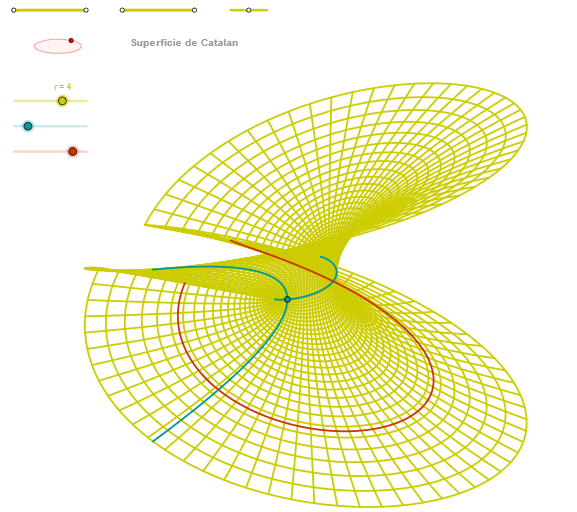
This GeoGebra example demonstrates how a Catalan-type surface (or its geometric construction/visual analogue) can be built and visualized using constrained conic interactions and parameter-driven geometry. It focuses on intuitive area-related interpretation by combining multiple geometric primitives and derived curves. Key mathematical concepts include analytic geometry through parametric point/curve construction, circle and ellipse geometry, intersection-based constraints, angle relations, and the use of difference/regression cues (as indicated by the original topic tags) to connect constructed quantities to an area measure or approximation. Construction highlights: it uses GeoGebra commands Segment, Point, OrthogonalLine (to impose perpendicular relationships), Circle, Intersect, Ellipse, Angle, CurveCartesian (for Cartesian curves derived from the parameters), and Sequence (to generate parameter steps/iterates). The construction involves many parameter points (e.g., u10, u20, P1–P4, Q1–Q4, v1, v2, u1–u4) and intermediate variables (zz/ZZ) that feed into derived conic/curve objects such as zElipse1, zElipse2, and zAngInc. Suitable for high-school to early university learners, especially for lessons on geometric construction, conic-based modeling, parameterized graphs/curves, and visualization of area-related quantities.
GeoGebra Commands & Parameters
Segment(Q3, Q4) → p2Point(p2) → P3Segment(P3, Q4) → p4Point(p4) → P4Segment(Q1, Q2) → p1Point(p1) → P1Segment(P1, Q2) → p3Point(p3) → P2OrthogonalLine(C, xAxis) → zz2Circle(C, 0.62) → zz0Intersect(zz0, zz2, 1) → ZZ4Intersect(zz0, zz2, 2) → ZZ3Ellipse(ZZ3, ZZ4, 0.65) → zElipse2Point(zElipse2) → ZIntersect(zElipse2, zz2) → ZZ7, ZZ8Angle(ZZ8, C, Z) → zAngIncOrthogonalLine(C, yAxis) → zz1Intersect(zz0, zz1, 2) → ZZ2Intersect(zz0, zz1, 1) → ZZ1Ellipse(ZZ1, ZZ2, 0.65) → zElipse1Point(zElipse1) → XYIntersect(zElipse1, zz1) → ZZ5, ZZ6Angle(ZZ6, C, XY) → zAngRotSegment(Q5, Q6) → p5Point(p5) → P5Segment(ZZ5, ZZ6) → zz4Segment(ZZ7, ZZ8) → zz3Intersect(zElipse2, zElipse1, 1) → zPunto1Intersect(zElipse2, zElipse1, 4) → zPunto2Segment(zPunto1, zPunto2) → zSeg2CurveCartesian((r / 8 * (((α - (sin(α) * cosh(v))) * sin(zAngRot)) + ((1 - (cos(α) * cosh(v))) * cos(zAngRot)))), (r / 8 * ((((-(α - (sin(α) * cosh(v)))) * cos(zAngRot)) * sin(zAngInc)) + (((1 - (cos(α) * cosh(v))) * sin(zAngRot)) * sin(zAngInc)) + (((4 * sin(α / 2)) * sinh(v / 2)) * cos(zAngInc)))), v, v1, v2) → curva2CurveCartesian((r / 8 * (((u - sin(u)) * sin(zAngRot)) + ((1 - cos(u)) * cos(zAngRot)))), (r / 8 * ((((-(u - sin(u))) * cos(zAngRot)) * sin(zAngInc)) + (((1 - cos(u)) * sin(zAngRot)) * sin(zAngInc)) + (((4 * sin(u / 2)) * sinh(0)) * cos(zAngInc)))), u, u1, u2) → curva1CurveCartesian((r / 8 * (((u - (sin(u) * cosh(β))) * sin(zAngRot)) + ((1 - (cos(u) * cosh(β))) * cos(zAngRot)))), (r / 8 * ((((-(u - (sin(u) * cosh(β)))) * cos(zAngRot)) * sin(zAngInc)) + (((1 - (cos(u) * cosh(β))) * sin(zAngRot)) * sin(zAngInc)) + (((4 * sin(u / 2)) * sinh(β / 2)) * cos(zAngInc)))), u, u1, u2) → a1Sequence(CurveCartesian[(r / 8 * (((u - (sin(u) * cosh(v))) * sin(zAngRot)) + ((1 - (cos(u) * cosh(v))) * cos(zAngRot)))), (r / 8 * ((((-(u - (sin(u) * cosh(v)))) * cos(zAngRot)) * sin(zAngInc)) + (((1 - (cos(u) * cosh(v))) * sin(zAngRot)) * sin(zAngInc)) + (((4 * sin(u / 2)) * sinh(v / 2)) * cos(zAngInc)))), v, v1, v2], u, u1, u2, paso) → list2Sequence(CurveCartesian[(r / 8 * (((u - (sin(u) * cosh(v))) * sin(zAngRot)) + ((1 - (cos(u) * cosh(v))) * cos(zAngRot)))), (r / 8 * ((((-(u - (sin(u) * cosh(v)))) * cos(zAngRot)) * sin(zAngInc)) + (((1 - (cos(u) * cosh(v))) * sin(zAngRot)) * sin(zAngInc)) + (((4 * sin(u / 2)) * sinh(v / 2)) * cos(zAngInc)))), u, u1, u2], v, v1, v2, paso) → list1
AI Drawing Prompt Reference
Draw a parametric surface with auxiliary geometric constructions. Start with two pairs of segments and moving points on them to form a base framework. Then construct a circle centered at the origin, and two perpendicular lines (parallel to the axes) intersecting the circle at four points. Use two of these points as foci to create two ellipses, place points on them, and measure related angles. Finally, generate three parametric curves: one along one parameter direction, one along the other, and one with a fixed parameter value, plus two families of curves to cover the surface. The overall shape is defined by ellipses, angles, and parametric curves.
The prompt above was compiled from the original drawing commands and is for reference only.