
Parallel Translation by Steve Phelps
Loading the math board and drawing, please wait…
In collections
Congruence (CO) Cluster
Congruence (Vol 1)
Congruence (Vol 1) Over 80 Resources
CCSS High School: Geometry (Congruence) Volume 1 S N ATTAR
Geometry (Congruence) Volume 1
CCSS High School: Geometry (Congruence) Volume 1
CCSS High School: Geometry (Congruence) Volume 1
CCSS High School: Geometry (Congruence) Volume 1
CCSS High School: Geometry (Congruence) Volume 1
CCSS High School: Geometry (Congruence) Volume 1
CCSS High School: Geometry (Congruence) Volume 1
CCSS High School: Geometry (Congruence) Volume 1
CCSS High School: Geometry (Congruence) Volume 1
CCSS High School: Geometry (Congruence) Volume 1
CCSS High School: Geometry (Congruence) Volume 1
CCSS High School: Geometry (Congruence) Volume 1
CCSS High School: Geometry (Congruence) Volume 1
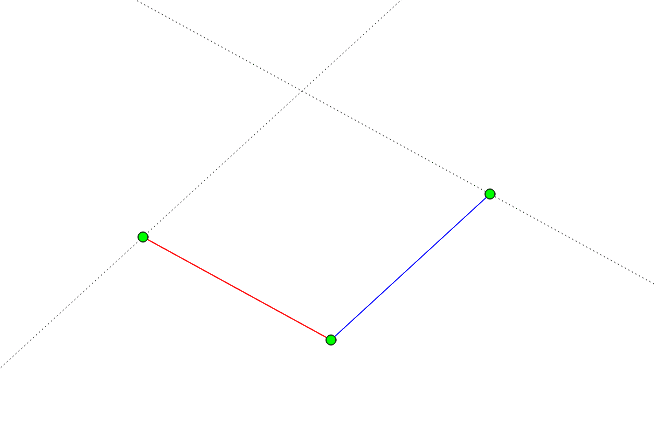
This example demonstrates the application of parallel translation in plane geometry, showcasing the process of translating shapes through vector transformations. Core mathematical concepts include vectors, translation transformations, parallelograms, and coordinate geometry. Construction highlights from the GeoGebra command summary involve segments, dilation, vectors, translation, and lines. Suitable for high school mathematics education, helping students understand the connection between geometric transformations and coordinate geometry.
GeoGebra Commands & Parameters
Segment(A, B) → aSegment(B, C) → bDilate(B, c, A) → B'Dilate(B, c, C) → B'_1Vector(B, B') → uVector(B, B'_1) → vTranslate(B, u) → B'_2Translate(C, u) → C'Segment(B'_2, C') → b'Translate(A, v) → A'Translate(B, v) → B'_3Segment(A', B'_3) → a'Line(A, b) → dLine(C, a) → e
AI Drawing Prompt Reference
Draw a parallelogram to illustrate the geometric process of parallel translation using vector transformations. Start by drawing two line segments, then obtain two new points through a similarity transformation based on one segment, and plot the corresponding vectors. Apply vector translation transformations to the original line segments and points to create new segments and points, forming two parallelograms. Connect the corresponding points with line segments and draw lines through key points to emphasize the connection between geometric transformations and coordinate geometry.
The prompt above was compiled from the original drawing commands and is for reference only.