
Parallel Lines & Related Angles: Task 6 (Try It Yourself)
Loading the math board and drawing, please wait…
In collections
Parallel Lines and Related Angles: Guided Exploration
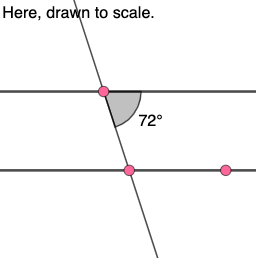
This GeoGebra example lets you actively work through a geometry task based on two parallel lines cut by a transversal, highlighting how related angles (e.g., corresponding/alternate/interior-angle relationships) behave in the configuration. The key math ideas are parallel lines, angle measurement, and geometric reasoning using invariant angle relationships. Construction highlights: Line, Ray, and Segment establish the main geometric entities; Point and Intersect define key vertices and intersection points; Angle is used to create and measure marked angles such as α and β; Rotate, Mirror, Translate, and Vector support transforming or matching angle positions under different configurations; Textfield and an InputBox enable labeling and parameter input; Circle and Random provide adjustable setups for repeated verification. Suitable for middle school to high school geometry practice, classroom exploration, and self-study focused on related angles.
GeoGebra Commands & Parameters
Line(A, B) → f_{1}Random(20, 160) → a_{1}Circle(A, 4) → c_{1}Intersect(c_{1}, f_{1}, 2) → CRotate(C, (a_{1} * π / 180), A) → C'Angle(C, A, C') → αIntersect(c_{1}, f_{1}, 1) → DAngle(C', A, D) → βMirror(C', A) → C''Ray(A, C'') → h_{1}Angle(D, A, C'') → γAngle(C'', A, C) → δLine(A, C') → g_{1}Point(g_{1}) → EVector(A, E) → uTranslate(f_{1}, u) → f'Translate(C, u) → C'_{1}Rotate(C'_{1}, (a_{1} * π / 180), E) → FRotate(F, π - (a_{1} * π / 180), E) → F'Rotate(F', (a_{1} * π / 180), E) → F''Angle(C'_{1}, E, F) → εAngle(F, E, F') → ζAngle(F', E, F'') → ηAngle(F'', E, C'_{1}) → θRandom(1, 8) → nTextfield(a) → InputBox1Segment(G, H) → iSegment(I, J) → jSegment(K, L) → kTextfield(b) → InputBox2Textfield(c) → InputBox3Textfield(d) → InputBox4Textfield(e) → InputBox5Textfield(f) → InputBox6Textfield(g) → InputBox7Textfield(h) → InputBox8
AI Drawing Prompt Reference
Draw two parallel lines intersected by a transversal. Create a circle at one intersection point, and measure the angles formed. Rotate a point around the intersection point by a random angle, and show the angles. Reflect the rotated point over the original intersection point, draw a ray, and measure related angles. Finally, translate and rotate line segments to demonstrate angle invariance.
The prompt above was compiled from the original drawing commands and is for reference only.