
Parallel Lines & Related Angles by Tim Brzezinski
Loading the math board and drawing, please wait…
In collections
Geometry: Parallel Lines & Related Angles
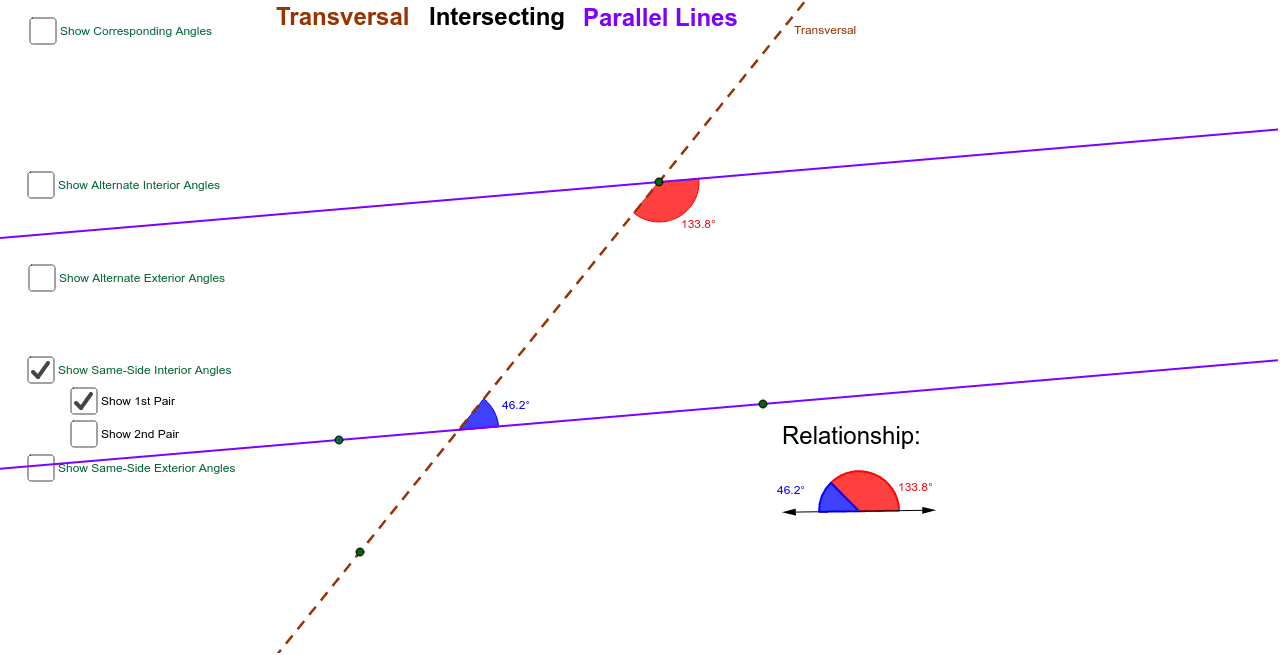
This GeoGebra applet is designed to help students explore and understand the relationships among the various angle-pairs formed when a transversal intersects two parallel lines. Key mathematical concepts include parallel lines, transversals, corresponding angles, alternate interior angles, and same-side interior angles. Using GeoGebra commands such as Line, Intersect, Angle, Rotate, etc., dynamic demonstrations of these angle relationships are provided. Suitable for middle school and above students studying geometry.
GeoGebra Commands & Parameters
Line(A, B) → aLine(E, F) → cIntersect(a, c) → KAngle(A, K, F) → ηAngle(F, K, B) → θLine(E, a) → bAngle(B, K, E) → αAngle(E, K, A) → βPoint(c) → CPoint(b) → GPoint(b) → HAngle(H, E, C) → γAngle(C, E, G) → δAngle(G, E, K) → εAngle(K, E, H) → ζAngle(K, E, H) → ιAngle(G, E, K) → κAngle(B, K, E) → λAngle(E, K, A) → μAngle(H, E, C) → νAngle(C, E, G) → ξAngle(A, K, F) → οAngle(F, K, B) → ρAngle(H, E, C) → σAngle(C, E, G) → τAngle(G, E, K) → υAngle(K, E, H) → ϕAngle(B, K, E) → χAngle(E, K, A) → ψAngle(A, K, F) → ωAngle(F, K, B) → α_1Line(D, I) → a_1Point(a_1) → JRotate(I, ϕ, J) → I'Angle(I, J, I') → β_1Rotate(I', χ, J) → I''Angle(I', J, I'') → γ_1Circle(J, 2) → c_1Intersect(c_1, a_1, 1) → MIntersect(c_1, a_1, 2) → NVector(J, N) → uVector(J, M) → vLine(O, P) → b_1Point(b_1) → QRotate(P, ϕ, Q) → P'Angle(P, Q, P') → δ_1Rotate(P', χ, Q) → P''Angle(P', Q, P'') → ε_1Circle(Q, 2) → d_1Intersect(d_1, b_1, 1) → RIntersect(d_1, b_1, 2) → SVector(Q, S) → wVector(Q, R) → u_1
AI Drawing Prompt Reference
Draw two parallel lines a and c, then draw a line b that intersects them. Mark the intersection point K and measure the angles ∠AKF, ∠FKB, ∠BEK, ∠AEK, ∠CEH, ∠GEH, ∠HEK, ∠KEH, ∠GEK, ∠KEG, ∠HEC, ∠GEC, ∠EKC, ∠BKE, ∠AEK, and ∠FKB. Next, draw a line d parallel to a, mark the intersection point I, rotate I around point J, and measure the rotated angles. Finally, draw a circle c1 with center J and radius 2, intersecting line a at points M and N, draw vectors u and v, then draw a line b1, mark the intersection point P, rotate P around point Q, and measure the rotated angles.
The prompt above was compiled from the original drawing commands and is for reference only.