
Parallel Lines and Transversal by Mathguru
Loading the math board and drawing, please wait…
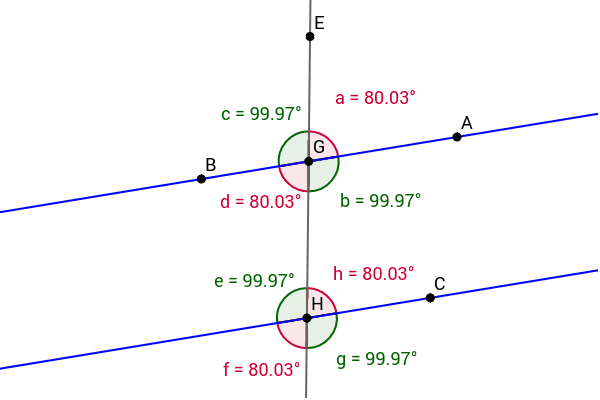
This example illustrates the geometric relationships formed when two parallel lines are intersected by a transversal, including corresponding angles, alternate interior angles, and so on. Key concepts include the properties of parallel lines, the definition of a transversal, and its relationship with parallel lines. Using GeoGebra commands such as Line, Intersect, and Angle, this example provides a visual demonstration of these geometric relationships, suitable for students at the middle school level and above.
GeoGebra Commands & Parameters
Line(A, B) → a_1Line(C, a_1) → b_1Point(b_1) → D_1Line(E, D) → c_1Intersect(c_1, a_1) → GIntersect(c_1, b_1) → HAngle(A, G, E) → aAngle(H, G, A) → bAngle(E, G, B) → cAngle(B, G, H) → dAngle(G, H, D_1) → eAngle(D_1, H, D) → fAngle(D, H, C) → gAngle(C, H, G) → hPoint(b_1) → D_2
AI Drawing Prompt Reference
Draw two parallel horizontal lines, one above the other. Then draw a diagonal transversal line crossing both parallel lines. At the two intersection points where the transversal meets each parallel line, mark eight angles: two on the left and two on the right at the upper line, and similarly two on the left and two on the right at the lower line. These angles illustrate corresponding, alternate interior, and consecutive interior angle relationships. Use distinct colors or labels to differentiate the angles, ensuring the diagram clearly shows the angle relationships formed by the parallel lines and transversal.
The prompt above was compiled from the original drawing commands and is for reference only.