
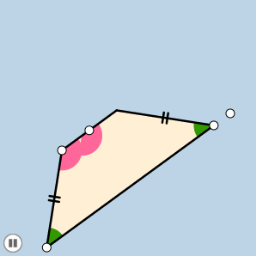
Parallel and Trapezoid Properties Animation
Loading the math board and drawing, please wait…
In collections
Congruence (CO) Cluster
Congruence (Vol 2)
CCSS High School: Geometry (Congruence) Volume 2
CCSS High School: Geometry (Congruence) Volume 2
CCSS High School: Geometry (Congruence) Volume 2
Geometry (Congruence) Volume 2
CCSS High School: Geometry (Congruence) Volume 2
CCSS High School: Geometry (Congruence) Volume 2
CCSS High School: Geometry (Congruence) Volume 2
CCSS High School: Geometry (Congruence) Volume 2
CCSS High School: Geometry (Congruence) Volume 2
CCSS High School: Geometry (Congruence) Volume 2
CCSS High School: Geometry (Congruence) Volume 2
Gail LeBlancCCSS High School: Geometry (Congruence) Volume 2
CCSS High School: Geometry (Congruence) Volume 2
This example demonstrates the geometric properties of parallelograms and trapezoids through animation, focusing on the relationships between angles, medians, and slopes. Key mathematical concepts include angles, trapezoids, slope differences, medians, ratios, hyperbolas, and squares. The construction utilizes GeoGebra commands and objects such as Line, Ray, Point, Midpoint, Slope, OrthogonalLine, Mirror, Dilate, Segment, Circle, Intersect, CircleSector, Vector, Translate, Angle, Rotate, and Polygon. Suitable for high school mathematics education to understand geometric transformations and properties.
GeoGebra Commands & Parameters
Line(A, B) → aRay(A, B) → bPoint(b) → CMidpoint(A, C) → DLine(A, C) → cSlope(c) → dOrthogonalLine(D, c) → gPoint(g) → ERay(D, E) → hPoint(h) → FSlope(h) → iLine(F, c) → lPoint(l) → GPoint(l) → HRay(F, G) → mRay(F, H) → nPoint(m) → IMirror(I, h) → I'Dilate(A, If[0 < o ≤ 1, 1 - o, 0], C) → A'Segment(A, A') → pDilate(A, If[1 < o ≤ 2, 2 - o, 0], I) → A'_1Segment(A, A'_1) → qSegment(A, C) → rSegment(C, I') → sSegment(I', I) → tSegment(I, A) → a_1Circle(A, (0.2 * Min[a_1, r])) → c_1Circle(I, (0.2 * Min[a_1, r])) → d_1Intersect(d_1, a_1, 1) → JIntersect(d_1, t, 1) → KIntersect(c_1, r, 1) → LIntersect(c_1, a_1, 1) → MCircleSector(A, L, M) → e_1CircleSector(I, J, K) → f_1Dilate(I, If[2 < o ≤ 3, 3 - o, 0], I') → I'_1Segment(I, I'_1) → b_1Dilate(A, If[3 < o ≤ 4, 4 - o, 0], C) → A'_2Vector(A, A'_2) → uTranslate(A, u) → A'_3Translate(A'_1, u) → NSegment(A'_3, N) → q'OrthogonalLine(A, r) → g_1Point(g_1) → OAngle(I, A, O) → αAngle(I', C, A) → βRotate(A'_3, If[4 < o ≤ 5, (((o - 4) * 2) * α), (2 * α)], C) → PRotate(N, If[4 < o ≤ 5, (((o - 4) * 2) * α), (2 * α)], C) → N'Segment(P, N') → q''Dilate(A, If[5 < o ≤ 6, 6 - o, 0], C) → A'_4Vector(A, A'_4) → vTranslate(e_1, v) → h_1Rotate(h_1, If[6 < o ≤ 7, ((o - 6) * ((2 * α) + β)), (2 * α) + β], C) → k_1Dilate(I, If[7 < o ≤ 8, 8 - o, 0], I') → I'_2Vector(I, I'_2) → wTranslate(f_1, w) → p_1Rotate(p_1, If[8 < o ≤ 9, ((-(o - 8)) * β), (-β)], I') → q_1Dilate(A, If[9 < o ≤ 10, 10 - o, 0], I') → A'_5Segment(A, A'_5) → i_1Dilate(A, If[10 < o ≤ 11, 11 - o, 0], I) → A'_6Vector(A, A'_6) → u_1Translate(A, u_1) → A'_7Translate(A'_5, u_1) → QSegment(A'_7, Q) → j_1Segment(I, C) → l_1Angle(L, A, I') → γRotate(A'_7, If[11 < o ≤ 12, ((-(o - 11)) * (2 * γ)), (-2 * γ)], I) → RRotate(Q, If[11 < o ≤ 12, ((-(o - 11)) * (2 * γ)), (-2 * γ)], I) → Q'Segment(R, Q') → m_1Polygon(A, C, I', I) → poly1, a_2, c_2, i', i_2