
Optimal Cylinder
Loading the math board and drawing, please wait…
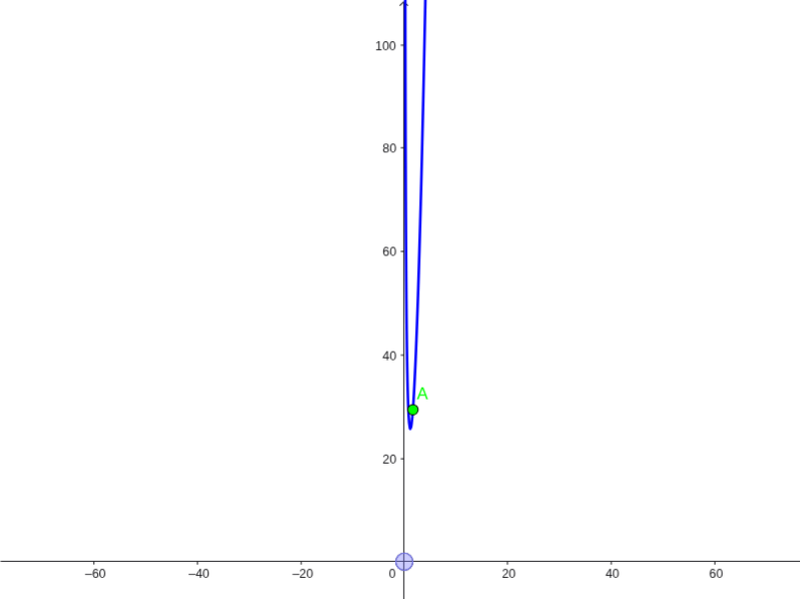
This example demonstrates that for a cylinder with fixed volume, the minimum surface area occurs when the cross-section is a square. It involves core concepts in solid geometry, calculus optimization, and geometric construction. Key GeoGebra commands used include Point, Intersect, Circle, Cylinder, Volume, PointIn, Cube to create the cylinder, cross-section, and calculate volume and surface area. Suitable for high school students and math enthusiasts exploring geometric optimization problems.
GeoGebra Commands & Parameters
Point(sa) → AIntersect(xAxis, zAxis) → BCircle(B, x(A), zAxis) → cCylinder(B, C, x(A)) → b, d, e, fVolume(b) → volumebPointIn(f) → PointfIntersect(xAxis, c) → D, ECube(E, D, xOyPlane) → g, F, faceDFJI, faceFGKJ, faceHIJK, edgeEG, edgeDE, edgeDF, edgeFG, edgeEH, edgeGK, edgeHK, G, edgeHI, edgeDI, edgeIJ, edgeFJ, edgeJK, H, I, J, K, faceDEGF, faceEGKH, faceDEHI
AI Drawing Prompt Reference
Draw a cylinder with a fixed volume, whose base center is at the origin and whose base lies on the horizontal plane, extending vertically. Inside the cylinder, construct an inscribed cube with its base coplanar with the cylinder's base, and its four lateral faces tangent to the cylinder's lateral surface. Also draw the cylinder's base circle and a horizontal diameter, marking the intersection points between the cylinder and the cube on the base. Show that when the cylinder's height equals its base diameter, its surface area is minimized, and its vertical cross-section is a square.
The prompt above was compiled from the original drawing commands and is for reference only.