
Octahedron Vertex Distribution Optimization
Loading the math board and drawing, please wait…
In collections
₈Polyhedra with extreme distribution of equivalent vertices
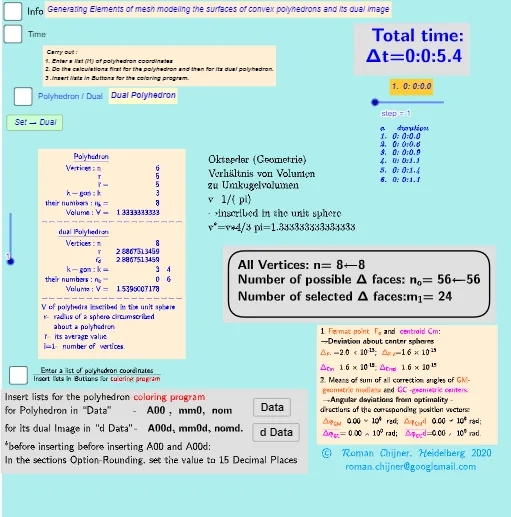
This example demonstrates the optimization of vertex distribution in an octahedron, adjusting parameter n=6 to observe extreme vertex arrangements. Core math concepts include geometric transformations, volume calculation, linear programming, and optimization. GeoGebra commands like If, Length, Sequence, Sum, Div, Element, TableText, Text, IndexOf, First, Max are used in construction. Suitable for high school students and math enthusiasts studying solid geometry and optimization problems.
GeoGebra Commands & Parameters
If(bu0, A00, A00d) → A00_0Length(A00_0) → nLength(l2) → läl2Sequence(sgn(Determinant[{Element[A00_0, i1] - Element[A00_0, j], Element[A00_0, i2] - Element[A00_0, j], Element[A00_0, i3] - Element[A00_0, j]}]), j, 1, n) → l01Length(A00d) → zzzSum(Zip[(T * F), T, SysTimeAkt1, F, {1, 1000, 60000, 3600000, 86400000}]) → TimeAbs1Sum(Zip[(T * F), T, SysTimeAkt2, F, {1, 1000, 60000, 3600000, 86400000}]) → TimeAbs2Div(TimeRelab, 3600) → HDiv(TimeRelab - (H * 3600), 60) → MElement(ZwZeit, step) → text10TableText({Append["a duration", Last[ZwZeit, Min[10, Length[ZwZeit]]]]}, "v") → text2cLength(A00) → lm1If(Length[Unique[l01 \ {0}]] ≟ 1, 7, -7) → a7Sum(Zip[(T * F), T, SysTimeAkt0, F, {1, 1000, 60000, 3600000, 86400000}]) → TimeAbs0Div(TimeRelab0, 3600) → H0Div(TimeRelab0 - (H0 * 3600), 60) → M0Text("" + (TimeRelab0 - (H0 * 3600) - (M0 * 60))) → S0aText("" + (TimeRelab - (H * 3600) - (M * 60))) → SIndexOf(".", S) → indexIndexOf(".", S0a) → indexaFirst(S, index + 1) → txtSFirst(S0a, indexa + 1) → txtS0aIf(bu0, " ", "d") → txtbuoMax(Length[A00], Length[A00d]) → maxläElement(A00, 24) → m11TableText({{"\underline{dual\;Polyhedron}"}, Append["Vertices: n=", {Length[A00d]}], Append["r=", {r_d}], Append[" \bar{r_d}= ", {r_md}], Append["k-gon : k=", mm5ad], Append["their\; numbers: n_k=", mm7ad], Append["Volume: V=", {Vold_r}]}, "hr ") → text20TableText({{"\underline{Polyhedron}"}, Append["Vertices: n=", {Length[A00]}], Append["r=", {r}], Append["\bar{r}=", {r_m}], Append["k-gon : k=", mm5a], Append["their\; numbers: n_k=", mm7a], Append["Volume: V=", {Vol_r}]}, "hr ") → text7
AI Drawing Prompt Reference
Draw a 3D octahedron and emphasize how its vertices are distributed. Use a parameter choice corresponding to n=6 to create an “extreme” vertex arrangement, and present the resulting dual comparison as well as the original polyhedron. Construct and display key geometric quantities derived from the vertex positions, including measures that correspond to a radius r and an upper-bar radius version, plus k-gon information (reporting the value of k and the count of their numbers). Include on-figure text showing the vertex counts n for both the polyhedron and its dual, and the respective volumes. Show the relationships between vertices, the derived distance-based measures, and the dual correspondence.
The prompt above was compiled from the original drawing commands and is for reference only.