
Hyperboloid of Two Sheets
Loading the math board and drawing, please wait…
In collections
geometriadinamica.es
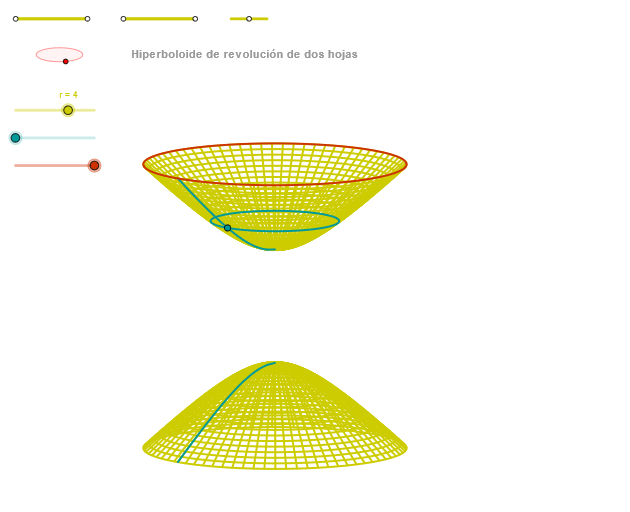
This example demonstrates the 3D geometric shape of a hyperboloid of two sheets and its properties. The core mathematical concepts involved include solid geometry, parametric equations, inequalities, and 3D curve plotting. The construction highlights the use of GeoGebra commands and objects such as Segment, Point, OrthogonalLine, Circle, Intersect, Ellipse, Angle, CurveCartesian, and Sequence as outlined in the construction summary. It is suitable for high school and above students studying solid geometry, calculus, and parametric equations, as well as for teaching demonstrations and geometric construction practice.
GeoGebra Commands & Parameters
Segment(Q5, Q6) → p5Point(p5) → P5Segment(Q3, Q4) → p2Point(p2) → P3Segment(P3, Q4) → p4Point(p4) → P4Segment(Q1, Q2) → p1Point(p1) → P1Segment(P1, Q2) → p3Point(p3) → P2OrthogonalLine(C, yAxis) → zz1Circle(C, 0.62) → zz0Intersect(zz0, zz1, 1) → ZZ1Intersect(zz0, zz1, 2) → ZZ2Ellipse(ZZ1, ZZ2, 0.65) → zElipse1Intersect(zElipse1, zz1) → ZZ5, ZZ6Point(zElipse1) → XYAngle(ZZ6, C, XY) → zAngRotOrthogonalLine(C, xAxis) → zz2Intersect(zz0, zz2, 2) → ZZ3Intersect(zz0, zz2, 1) → ZZ4Ellipse(ZZ3, ZZ4, 0.65) → zElipse2Intersect(zElipse2, zz2) → ZZ7, ZZ8Point(zElipse2) → ZAngle(ZZ8, C, Z) → zAngIncSegment(ZZ5, ZZ6) → zz4Segment(ZZ7, ZZ8) → zz3Intersect(zElipse2, zElipse1, 1) → zPunto1Intersect(zElipse2, zElipse1, 4) → zPunto2Segment(zPunto1, zPunto2) → zSeg2CurveCartesian((r * ((((a * sqrt(u^(2) - 1)) * cos(α)) * sin(zAngRot)) + (((b * sqrt(u^(2) - 1)) * sin(α)) * cos(zAngRot)))), (r * ((((((-a) * sqrt(u^(2) - 1)) * cos(α)) * cos(zAngRot)) * sin(zAngInc)) + ((((b * sqrt(u^(2) - 1)) * sin(α)) * sin(zAngRot)) * sin(zAngInc)) + ((c * u) * cos(zAngInc)))), u, (-u2), u2) → curva2Sequence(CurveCartesian[(r * ((((a * sqrt(u^(2) - 1)) * cos(v)) * sin(zAngRot)) + (((b * sqrt(u^(2) - 1)) * sin(v)) * cos(zAngRot)))), (r * ((((((-a) * sqrt(u^(2) - 1)) * cos(v)) * cos(zAngRot)) * sin(zAngInc)) + ((((b * sqrt(u^(2) - 1)) * sin(v)) * sin(zAngRot)) * sin(zAngInc)) + ((c * u) * cos(zAngInc)))), v, v1, v2], u, u1, u2, paso) → list1ASequence(CurveCartesian[(r * ((((a * sqrt(u^(2) - 1)) * cos(v)) * sin(zAngRot)) + (((b * sqrt(u^(2) - 1)) * sin(v)) * cos(zAngRot)))), (r * ((((((-a) * sqrt(u^(2) - 1)) * cos(v)) * cos(zAngRot)) * sin(zAngInc)) + ((((b * sqrt(u^(2) - 1)) * sin(v)) * sin(zAngRot)) * sin(zAngInc)) + ((c * u) * cos(zAngInc)))), v, v1, v2], u, (-u2), (-u1), paso) → list2ACurveCartesian((r * ((((a * sqrt(1.5^(2) - 1)) * cos(v)) * sin(zAngRot)) + (((b * sqrt(1.5^(2) - 1)) * sin(v)) * cos(zAngRot)))), (r * ((((((-a) * sqrt(1.5^(2) - 1)) * cos(v)) * cos(zAngRot)) * sin(zAngInc)) + ((((b * sqrt(1.5^(2) - 1)) * sin(v)) * sin(zAngRot)) * sin(zAngInc)) + ((c * 1.5) * cos(zAngInc)))), v, v1, v2) → curva1CurveCartesian((r * ((((a * sqrt(β^(2) - 1)) * cos(v)) * sin(zAngRot)) + (((b * sqrt(β^(2) - 1)) * sin(v)) * cos(zAngRot)))), (r * ((((((-a) * sqrt(β^(2) - 1)) * cos(v)) * cos(zAngRot)) * sin(zAngInc)) + ((((b * sqrt(β^(2) - 1)) * sin(v)) * sin(zAngRot)) * sin(zAngInc)) + ((c * β) * cos(zAngInc)))), v, v1, v2) → a1Sequence(CurveCartesian[(r * ((((a * sqrt(u^(2) - 1)) * cos(v)) * sin(zAngRot)) + (((b * sqrt(u^(2) - 1)) * sin(v)) * cos(zAngRot)))), (r * ((((((-a) * sqrt(u^(2) - 1)) * cos(v)) * cos(zAngRot)) * sin(zAngInc)) + ((((b * sqrt(u^(2) - 1)) * sin(v)) * sin(zAngRot)) * sin(zAngInc)) + ((c * u) * cos(zAngInc)))), u, (-u2), (-u1)], v, v1, v2, paso) → list2Sequence(CurveCartesian[(r * ((((a * sqrt(u^(2) - 1)) * cos(v)) * sin(zAngRot)) + (((b * sqrt(u^(2) - 1)) * sin(v)) * cos(zAngRot)))), (r * ((((((-a) * sqrt(u^(2) - 1)) * cos(v)) * cos(zAngRot)) * sin(zAngInc)) + ((((b * sqrt(u^(2) - 1)) * sin(v)) * sin(zAngRot)) * sin(zAngInc)) + ((c * u) * cos(zAngInc)))), u, u1, u2], v, v1, v2, paso) → list1
AI Drawing Prompt Reference
Draw a hyperboloid of two sheets, including two elliptical rings, two cone bodies, two cone bodies' intersection points, two cone bodies' intersection points' line segments, two cone bodies' intersection points' line segments' intersection points, and a hyperbola. The hyperbola's parametric equation is determined by parameters r, a, b, c, u, v, α, β, zAngRot, zAngInc, etc.
The prompt above was compiled from the original drawing commands and is for reference only.