
Octagon Medians Construction
Loading the math board and drawing, please wait…
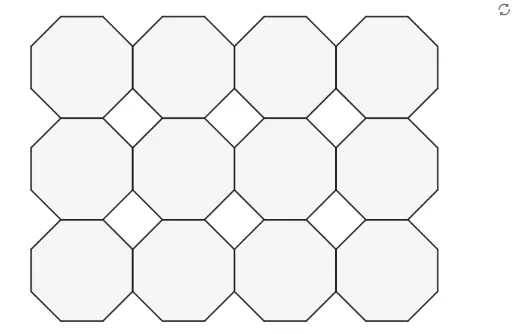
This example demonstrates the geometric construction and properties of medians in an octagon. It involves core mathematical concepts such as symmetry, polygon construction, midpoint calculation, and vector operations. The construction utilizes GeoGebra commands and objects like Intersect, ConstructionStep, Point, Polygon, Midpoint, Segment, PolyLine, Vector, and Sequence. It is suitable for high school mathematics education, helping students understand geometric constructions and spatial relationships.
GeoGebra Commands & Parameters
Intersect(xAxis, yAxis) → AConstructionStep() → stapPoint(xAxis) → BPolygon(A, B, 8) → veelhoek1, f, D, E, F, G, H, g, h, i, j, k, l, m, CPolygon(D, C, 8) → veelhoek2, n, J, K, L, M, N, p, q, r, s, t, a, b, IPolygon(L, K, 8) → veelhoek3, c, P, Q, R, S, T, d, e, f_1, g_1, h_1, i_1, j_1, OPolygon(R, Q, 8) → veelhoek4, k_1, V, W, Z, A_1, B_1, l_1, m_1, n_1, p_1, q_1, r_1, s_1, UPolygon(B, A, 8) → veelhoek5, t_1, D_1, E_1, F_1, G_1, H_1, a_1, b_1, c_1, d_1, e_1, f_2, g_2, C_1Polygon(J, I, 8) → veelhoek6, h_2, J_1, K_1, L_1, M_1, N_1, i_2, j_2, k_2, l_2, m_2, n_2, p_2, I_1Polygon(P, O, 8) → veelhoek7, q_2, P_1, Q_1, R_1, S_1, T_1, r_2, s_2, t_2, a_2, b_2, c_2, d_2, O_1Polygon(V, U, 8) → veelhoek8, e_2, V_1, W_1, Z_1, A_2, B_2, f_3, g_3, h_3, i_3, j_3, k_3, l_3, U_1Polygon(F, E, 8) → veelhoek9, m_3, D_2, E_2, F_2, G_2, H_2, n_3, p_3, q_3, r_3, s_3, t_3, a_3, C_2Polygon(N, M, 8) → veelhoek10, b_3, J_2, K_2, L_2, M_2, N_2, c_3, d_3, e_3, f_4, g_4, h_4, i_4, I_2Polygon(T, S, 8) → veelhoek11, j_4, P_2, Q_2, R_2, S_2, T_2, k_4, l_4, m_4, n_4, p_4, q_4, r_4, O_2Polygon(B_1, A_1, 8) → veelhoek12, s_4, V_2, W_2, Z_2, A_3, B_3, t_4, a_4, b_4, c_4, d_4, e_4, f_5, U_2Midpoint(f) → C_3Midpoint(g) → D_3Midpoint(h) → E_3Midpoint(i) → F_3Midpoint(j) → G_3Midpoint(k) → H_3Midpoint(l) → I_3Midpoint(m) → J_3Segment(C_3, E_3) → g_5Segment(D_3, F_3) → h_5Segment(E_3, G_3) → i_5Segment(F_3, H_3) → j_5Segment(G_3, I_3) → k_5Segment(H_3, J_3) → l_5Segment(I_3, C_3) → m_5Segment(J_3, D_3) → n_5Intersect(i_5, j_5) → K_3Intersect(j_5, k_5) → L_3Intersect(k_5, l_5) → M_3Intersect(l_5, m_5) → N_3Segment(C_3, E_3) → p_5Intersect(m_5, n_5) → O_3Intersect(n_5, p_5) → P_3Intersect(h_5, p_5) → Q_3Intersect(h_5, i_5) → R_3PolyLine(G_3, L_3, D_3, Q_3, E_3, R_3, F_3, K_3, G_3, H_3, M_3, I_3, N_3, J_3, O_3, C_3, P_3) → q_5Vector(A, I) → horVector(A, F) → vertSequence(Translate[Sequence[PolyLine[Translate[G_3, Vector[(nn * hor)]], Translate[L_3, Vector[(nn * hor)]], Translate[H_3, Vector[(nn * hor)]], Translate[M_3, Vector[(nn * hor)]], Translate[I_3, Vector[(nn * hor)]], Translate[N_3, Vector[(nn * hor)]], Translate[J_3, Vector[(nn * hor)]], Translate[O_3, Vector[(nn * hor)]], Translate[C_3, Vector[(nn * hor)]], Translate[P_3, Vector[(nn * hor)]], Translate[D_3, Vector[(nn * hor)]], Translate[Q_3, Vector[(nn * hor)]], Translate[E_3, Vector[(nn * hor)]], Translate[R_3, Vector[(nn * hor)]], Translate[F_3, Vector[(nn * hor)]], Translate[K_3, Vector[(nn * hor)]], Translate[G_3, Vector[(nn * hor)]]], nn, 0, 3], Vector[(mm * vert)]], mm, -1, 1) → l1Polygon(B, H_1, I, C) → vierhoek1, b_5, r_5, i_6, c_5Sequence(Translate[Sequence[Polygon[Translate[B, Vector[(nn * hor)]], Translate[H_1, Vector[(nn * hor)]], Translate[I, Vector[(nn * hor)]], Translate[C, Vector[(nn * hor)]]], nn, 0, 2], Vector[(mm * vert)]], mm, 0, 1) → l2
AI Drawing Prompt Reference
Draw a regular octagon and construct the midpoints of its diagonals to form a new octagon. Then, construct a series of parallelograms with the sides of the original octagon as bases, resulting in a centrally symmetric figure.
The prompt above was compiled from the original drawing commands and is for reference only.