
Number of Solutions of Simultaneous Linear Equations in Two Unknowns
Loading the math board and drawing, please wait…
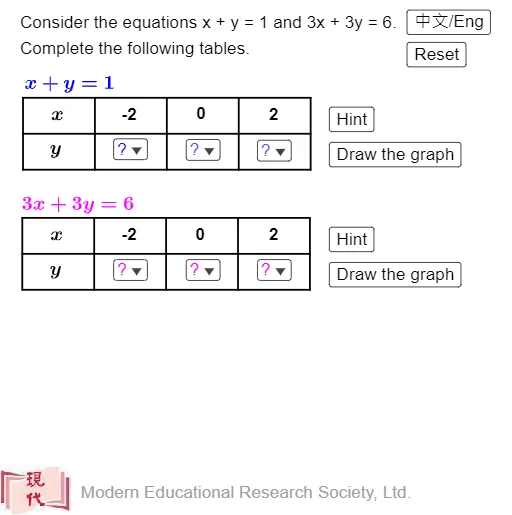
This example demonstrates the number of solutions for simultaneous linear equations in two unknowns. Key mathematical concepts include linear equations and their geometric interpretations. Using GeoGebra commands such as Sequence, Textfield, and Line, the example dynamically shows the solutions under different coefficients. Suitable for students at the middle school level and above, particularly for learning linear algebra and coordinate geometry.
GeoGebra Commands & Parameters
Sequence(Segment[(x(T_1) + (2 * k), y(T_1)), (x(T_1) + (2 * k), y(T_1) + 2)], k, 0, 4) → t_1Sequence(Segment[(x(T_1), y(T_1) + k), (x(T_1) + 8, y(T_1) + k)], k, 0, 2) → t_2Sequence(Segment[(x(T_2) + (2 * k), y(T_2)), (x(T_2) + (2 * k), y(T_2) + 2)], k, 0, 4) → t_3Sequence(Segment[(x(T_2), y(T_2) + k), (x(T_2) + 8, y(T_2) + k)], k, 0, 2) → t_4Textfield(f) → InputBox1Textfield(g) → InputBox2Line(A_1, A_2) → f_2Line(A_4, A_5) → g_2Line(A_2, A_3) → f_3Line(A_5, A_6) → g_3Corner(2, 1) → CCorner(2, 1) → Z
AI Drawing Prompt Reference
Draw two parallel lines labeled f and g, and add several parallel line segments above and below each line to create a stepped pattern. Include two diagonal lines intersecting the parallel lines, marking the intersection points. Add a text box in the upper left corner for inputting coefficient values.
The prompt above was compiled from the original drawing commands and is for reference only.