
Normal to a Surface
Loading the math board and drawing, please wait…
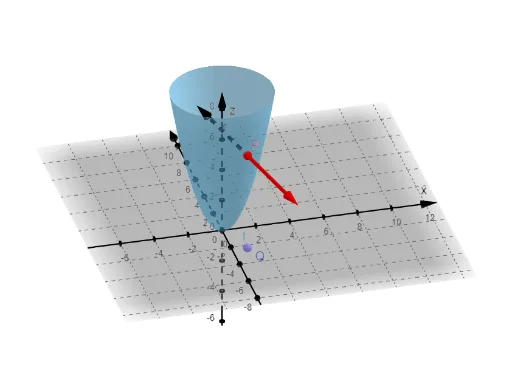
This example demonstrates how to find the normal to a surface in 3D space. Key mathematical concepts include vectors and derivatives. Using GeoGebra commands such as Derivative and Vector, the construction of the normal to the surface is shown. Suitable for university mathematics and related professional students studying 3D geometry and calculus.
GeoGebra Commands & Parameters
Derivative(f(x, y), x) → fxDerivative(f(x, y), y) → fyVector((a, b)) → uVector((l, m, 0), (l - a, m - b, 0)) → vVector((l, m, n), (l + a, m + b, n - 1)) → wVector((l, m, n), (l - a, m - b, n + 1)) → r
AI Drawing Prompt Reference
Draw a smooth surface in 3D space and illustrate the normal vector at a specific point on it. Start by showing two partial derivative vectors that lie in the tangent plane at that point. Then, from the same point, draw two vectors pointing outward and inward along the normal direction, together representing the normal line. The final image should include the surface, the tangent plane vectors, and the normal vector, clearly demonstrating the geometric relationship between derivatives and the surface normal.
The prompt above was compiled from the original drawing commands and is for reference only.