
Newtonian Gravitation Dynamics in a Nutshell
Loading the math board and drawing, please wait…
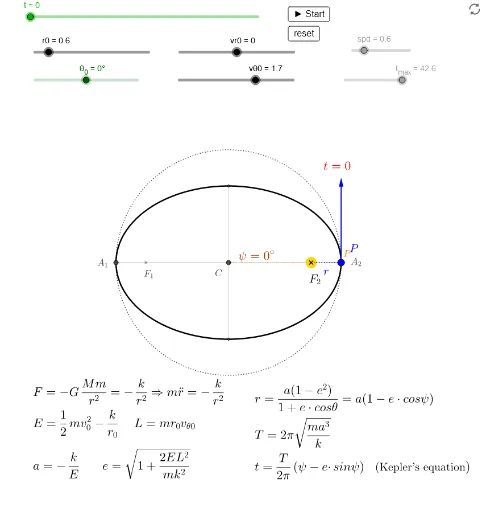
This example demonstrates the relationship between motion trajectories and related physical quantities in Newtonian gravitation dynamics. Core mathematical concepts include vectors, derivatives, parametric equations, and coordinate geometry. Construction highlights involve commands like Angle, Intersect, Derivative, Segment, Midpoint, CurveCartesian, Circle, Vector, Tangent, as per the GeoGebra command summary. Suitable for high school students and beginners interested in celestial mechanics.
GeoGebra Commands & Parameters
Angle((fucosϕ(θ_0 - w), fusinϕ(θ_0 - w))) → ϕt0Intersect(g, tit, (0, 0)) → Eg2Intersect(g, tia, (0, 0)) → EgDerivative(g) → gdSegment(A_1, A_2) → axaMidpoint(axa) → CSegment(Pa', Mirror[Pa', axa]) → hhaAngle(A_2, C, Pa') → ϕvaSegment(C, Pa') → rcSegment(Pt', Mirror[Pt', axa]) → hhtAngle(A_2, C, Pt') → ϕvtCurveCartesian(((a * (1 - e^(2)) / (1 + (e * cos(θ - w)))); θ), θ, 0, (2 * π)) → el0Circle(C, a) → CiAngle((fucosθ(ϕa), fusinθ(ϕa))) → θaAngle((fucosθ(ϕt), fusinθ(ϕt))) → θtVector(Pt0, Pt0 + (vsca * ((vr0; θ_0) + (vθ0; θ_0 + π / 2)))) → vv0Segment(C, Pt') → rc_tVector(Pt', Pt' + ((vvci * vsca) * ((-sin(ϕt + w)), cos(ϕt + w)))) → vvϕtAngle((fucosθ(ϕt), fusinθ(ϕt))) → θtrad_{temp}Segment(F_2, Pt) → re_tTangent(Pt, el0) → tgcheckAngle(xAxis, re_t) → θtcheckggbVector(Pt, Pt + (vsca * (((rθfu(θt + w) * θ'(ϕt)); θt + w + π / 2) + ((rθfu'(θt + w) * θ'(ϕt)); θt + w)))) → vvPtSegment(Pt', Pt) → segPP'Vector(Eg2, Psi) → vpsiVector(Psit, Eg2) → vpsitSegment(B_1, B_2) → axbCircle(F_2, a / 20) → sun
AI Drawing Prompt Reference
Draw a diagram of Newtonian gravitational dynamics: an elliptical orbit with a small circle at one focus representing the central body. Mark two points on the orbit, draw segments from the focus to each point, and at each point show the tangent line, velocity vectors (decomposed into radial and transverse components), and a segment toward the focus. Include an auxiliary circle, coordinate axes, several angle markers (such as orbital parameter angle and velocity direction angle), and a segment connecting the two points. Overall, illustrate the relationship between orbital geometry and kinematic quantities.
The prompt above was compiled from the original drawing commands and is for reference only.