
Triple Sun: Parametric rotation and ODE-driven geometry from circles
Loading the math board and drawing, please wait…
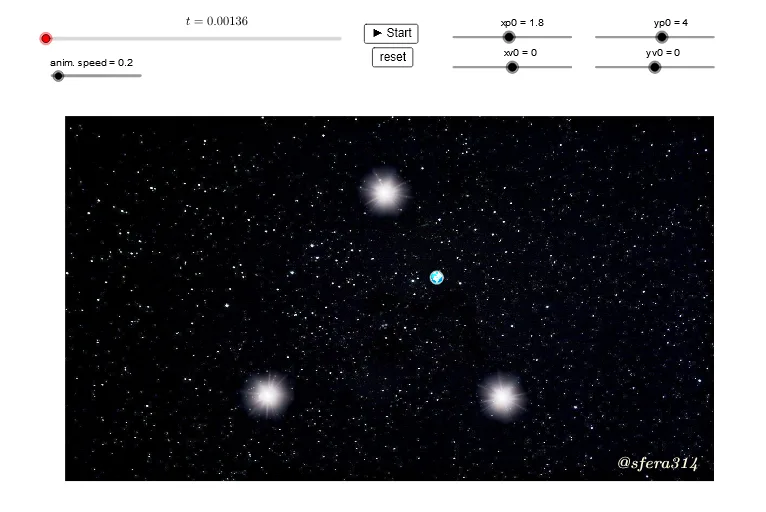
This example visualizes a “triple sun” composite by constructing multiple circular structures whose positions and sizes evolve through rotation and constraint-based parameter updates. It demonstrates how geometric similarity and circle geometry can be coupled with differential-equation solutions to create coordinated motion and a recognizable multi-circle motif. Key math concepts include circle relationships via distances/lengths, similarity-triangle style constraints for tying angles or scale factors, exponential/weight-like parameters and correlation-type reasoning for controlling proportions, and numerical solution of ordinary differential equations using NSolveODE to obtain time-dependent parameters. Construction highlights: Circle is used to build the base circles (e.g., S1, S2, S3 with associated coordinate objects such as xs1/ys1, xs2/ys2, xs3/ys3, and a length measure like len). Vector, Distance/Length provide directional and metric constraints (including anchor points such as xp0/yp0 and parameters k1, k2, k3). Rotate performs the geometric transformation that overlays rotated copies, while NSolveODE (with time horizon t_max and initial values like xv0/yv0) computes derivatives (xv', yv', xp', yp') whose solutions (sol_1–sol_4, accessed via First) drive the animated geometry and visual attributes (e.g., starsize and related size controls). Suitable for advanced secondary students and introductory university courses in calculus, parametric modeling, and transformation-based geometry visualization.
GeoGebra Commands & Parameters
NSolveODE({xp', xv', yp', yv'}, 0, {xp0, xv0, yp0, yv0}, t_{max}) → sol_{1}, sol_{2}, sol_{3}, sol_{4}Length(sol_{1}) → lenDistance(P, S3) → ds3Distance(P, S1) → ds1Distance(P, S2) → ds2Distance(P0, S1) → ds01Distance(P0, S2) → ds02Distance(P0, S3) → ds03Vector(P0, P0 + ((vsca * ((-k1)) / Distance[P0, S1]^(2)) * UnitVector[Vector[S1, P0]])) → f10Vector(P0, P0 + ((vsca * ((-k2)) / Distance[P0, S2]^(2)) * UnitVector[Vector[S2, P0]])) → f20Vector(P0, P0 + ((vsca * ((-k3)) / Distance[P0, S3]^(2)) * UnitVector[Vector[S3, P0]])) → f30Vector(P0, P0 + f10 + f20 + f30) → ftot0Vector(P, P + ((vsca * ((-k1)) / Distance[P, S1]^(2)) * UnitVector[Vector[S1, P]])) → f1Vector(P, P + ((vsca * ((-k2)) / Distance[P, S2]^(2)) * UnitVector[Vector[S2, P]])) → f2Vector(P, P + ((vsca * ((-k3)) / Distance[P, S3]^(2)) * UnitVector[Vector[S3, P]])) → f3Vector(P, P + f1 + f2 + f3) → ftotVector(P + f1, P + f1 + f3) → f3'Vector(P + f1 + f3, P + f1 + f3 + f2) → f2'Vector(P, P + (vscav * (y(Point[sol_{2}, t]), y(Point[sol_{4}, t])))) → vvpCircle(S1, rstar) → cs1Circle(S2, rstar) → cs2Circle(S3, rstar) → cs3Circle(P, rpla + 0.03) → plaRotate(earth_{LM}, (30 * t), P) → earth_{rot}Rotate(Star1, αs1t, SS1A + (starsize1 / 2, starsize1 / 2)) → Star1rotRotate(Star2, αs2t, SS2A + (starsize2 / 2, starsize2 / 2)) → Star2rotRotate(Star3, αs3t, SS3A + (starsize3 / 2, starsize3 / 2)) → Star3rotZip(Point[{p, q}], p, liu, q, liw) → liuwFirst(Sequence[liuw(j), j, 1, len, 8], floor((t * floor(len / 8)) + 1)) → liuwt0
AI Drawing Prompt Reference
In one coordinate plane, construct three base circles with common radius rstar centered at S1, S2, and S3, and introduce a moving point P0 that evolves in time. Use the distances from P0 to S1, S2, and S3 to define three vectors directed along the lines toward each center; sum them to obtain the total directional influence. Update the time-dependent parameters by an ODE-based numerical solve so that the point P follows the resulting motion. Use the distances from P to S1, S2, and S3 to tie the proportions of the configuration, then apply rotations to create the “triple sun” effect: rotate an earth-like element around earth_{LM} by an angle proportional to t, and rotate three star-like elements around SS1A, SS2A, SS3A by angles αs1t, αs2t, αs3t with their rotation centers shifted according to starsize controls. Display the overlapping circles and rotated stars to obtain a coordinated multi-circle motif.
The prompt above was compiled from the original drawing commands and is for reference only.