
Uniform Circular Motion with Polar Coordinates
Loading the math board and drawing, please wait…
In collections
The Domain of the Time (intuitive kinematics)
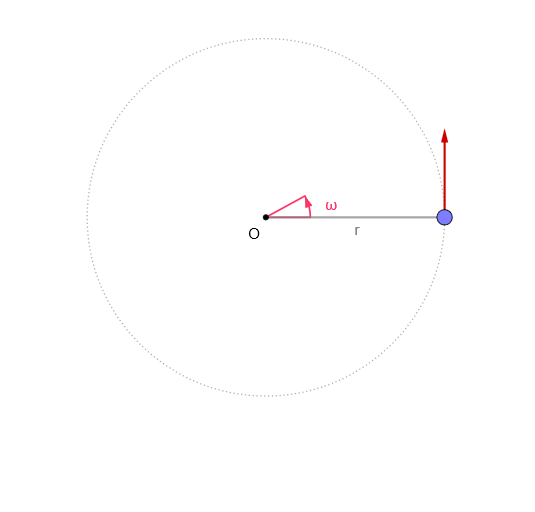
This example demonstrates the motion of uniform circular motion in polar coordinates, illustrating the relationship between angular velocity, arc length, and parametric equations. Key mathematical concepts include polar coordinates, angular velocity, arc length, and parametric equations. Construction highlights involve commands like Circle, Segment, If, mean, Angle, along with animation and time control objects such as anima, reinicia, empieza, t0/t1/dt, tt, M, s, reg, laps, regDif, T, ω, α, P, v, f, tPause, t, and tPauseAux. Suitable for high school physics and mathematics education, focusing on kinematic analysis in polar coordinates.
GeoGebra Commands & Parameters
Circle((0, 0), r) → cSegment(O, M) → sIf(Length[reg] ≟ 1, {reg(1)}, Sequence[reg(k) - reg(k + 1), k, 1, Length[reg] - 1]) → regDifmean(regDif) → TAngle((1, 0), O, Rotate[(1, 0), ω]) → αSegment(O, P) → f
AI Drawing Prompt Reference
Draw a 2D coordinate plane with a circle centered at the origin O with radius r. Choose a point M on the circle and connect O to M with a radius segment. Define a sequence reg related to arc-length measurements, compute regDif as differences of consecutive terms, then take the mean of regDif to represent a period T. From the reference direction (1,0), draw the angle α at O between (1,0) and the rotated direction obtained by rotating (1,0) around O by ω. Finally, draw a segment from O to a point P, using these circle, radius, angle α, and segment OP together as an illustration of uniform circular motion in polar-coordinate style relationships (linking angular velocity ω, arc-length sequence reg, and the period T).
The prompt above was compiled from the original drawing commands and is for reference only.