
New Pythagorean Theorem for Non-Similar Circles
Loading the math board and drawing, please wait…
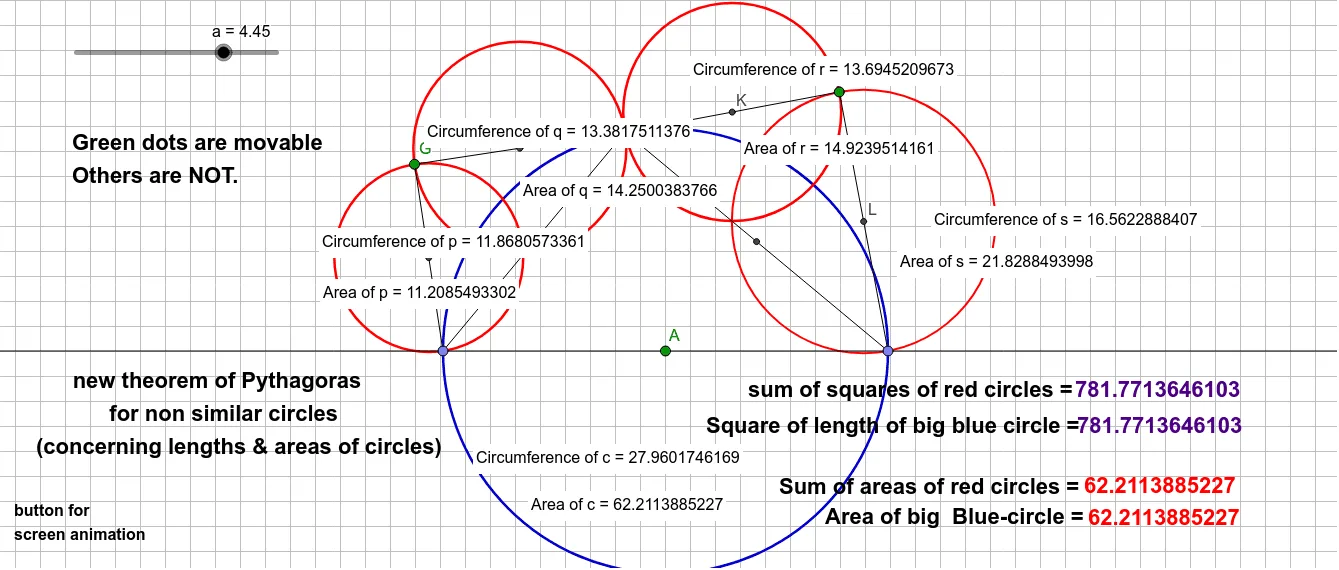
This example demonstrates a new Pythagorean theorem for non-similar circles. It involves key mathematical concepts such as geometric mean and geometric transformations. Using GeoGebra commands like Circle, Point, Line, Segment, Midpoint, Circumference, PointIn, Area, the construction of this interesting geometric phenomenon is achieved. Suitable for high school geometry learners and math enthusiasts.
GeoGebra Commands & Parameters
Circle(A, a) → cPoint(c) → CPoint(c) → BLine(C, B) → fPoint(c) → DSegment(D, C) → gSegment(D, B) → hMidpoint(C, D) → EMidpoint(D, B) → FCircle(E, D) → dCircle(F, D) → ePoint(d) → GSegment(G, C) → iSegment(G, D) → jPoint(e) → HSegment(D, H) → kSegment(H, B) → lMidpoint(G, C) → IMidpoint(G, D) → JMidpoint(D, H) → KMidpoint(H, B) → LCircle(I, G) → pCircle(J, G) → qCircle(K, D) → rCircle(L, H) → sCircumference(p) → cepPointIn(p) → Pointp_1Circumference(q) → ceqPointIn(q) → Pointq_1Circumference(r) → cerPointIn(r) → Pointr_1Circumference(s) → cesPointIn(s) → Points_1Circumference(c) → downbigPointIn(c) → Pointc_1Circumference(c) → circumferencecPointIn(c) → Pointc_2Area(p) → bPointIn(p) → PointpArea(q) → mPointIn(q) → PointqArea(r) → nPointIn(r) → PointrArea(s) → oPointIn(s) → PointsArea(c) → tPointIn(c) → Pointc