
Net of a Pyramid by Sudeep Gokarakonda
Loading the math board and drawing, please wait…
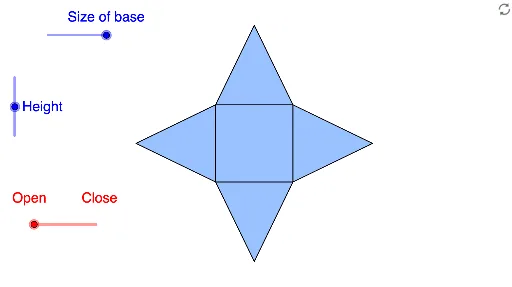
This example demonstrates the net of a pyramid, showing how the surfaces of a pyramid unfold into a 2D plane. Key math concepts include polygons, solid geometry, geometric construction, rotation, and translation. It is constructed using GeoGebra commands such as Point, Segment, Line, Circle, Intersect, Rotate, Polygon, OrthogonalLine, Midpoint, Vector, Translate, LineBisector, CircleArc, Ray, and If. Suitable for high school solid geometry education, helping students understand the relationship between 3D shapes and their 2D nets, and developing spatial reasoning skills.
GeoGebra Commands & Parameters
Point(Circle[A, l]) → BSegment(A, B) → aLine(A, B) → b_2Circle(B, (3 * l / 4.5)) → cIntersect(c, b_2, 2) → CRotate(C, 30°, B) → C'Line(C', b_2) → dSegment(B, C') → eLine(A, e) → fIntersect(d, f) → DPolygon(A, B, C', D) → poly1, a_1, b_1, c', d_1Segment(A, C') → gSegment(D, B) → h_1Intersect(g, h_1) → EOrthogonalLine(E, a_1) → iCircle(E, h) → kIntersect(k, i, 2) → FSegment(B, F) → jSegment(C', F) → l_5Segment(F, D) → mSegment(F, A) → nSegment(A, D) → qMidpoint(b_1) → GSegment(G, F) → rLine(E, G) → c_1Circle(G, F) → f_1Intersect(f_1, c_1, 2) → HIntersect(c_1, d_1) → ICircle(I, F) → g_1Intersect(g_1, c_1, 1) → JVector(F, J) → uPoint(c') → LCircle(L, F) → q_1Vector(F, H) → wMidpoint(A, B) → KLine(K, E) → e_1Circle(K, h) → p_1Intersect(e_1, c') → MCircle(M, h) → r_1Intersect(r_1, e_1, 2) → NIntersect(p_1, e_1, 1) → OVector(F, N) → vVector(F, O) → zTranslate(F, Vector[(z * o)]) → F'_1Translate(F, Vector[(u * (o - 1))]) → F'_2Translate(F, Vector[(v * (o - 2))]) → F'_3Translate(F, Vector[(w * (o - 3))]) → F'Segment(F, N) → sLineBisector(s) → a_2Intersect(a_2, c') → PCircleArc(P, N, F) → c_2Ray(P, F'_3) → d_2Intersect(c_2, d_2, 1) → QSegment(F, O) → e_2LineBisector(e_2) → f_2Intersect(f_2, a_1) → RCircleArc(R, F, O) → g_2Ray(R, F'_1) → h_2Intersect(g_2, h_2, 1) → SCircleArc(I, F, J) → k_2CircleArc(G, H, F) → p_2Ray(I, F'_2) → i_2Intersect(k_2, i_2, 1) → TRay(G, F') → j_2Intersect(p_2, j_2, 1) → UCircle(I, E) → s_1OrthogonalLine(I, a_1) → i_1Intersect(s_1, i_1, 2) → VIntersect(s_1, i_1, 1) → WOrthogonalLine(V, i_1) → j_1OrthogonalLine(W, i_1) → k_1OrthogonalLine(G, k_1) → l_1Intersect(j_1, l_1) → ZIntersect(k_1, l_1) → A_1Midpoint(V, Z) → B_1Midpoint(A_1, W) → C_1Circle(B_1, r) → t_1Circle(C_1, r) → q_2OrthogonalLine(B_1, k_1) → m_1Intersect(t_1, m_1, 1) → D_1Intersect(q_2, m_1, 2) → E_1Vector(C', Z) → u_1Vector(B, A_1) → v_1Vector(N, D_1) → w_1Vector(O, E_1) → z_1Translate(N, Vector[(w_1 * (o - 4))]) → N'Translate(O, Vector[(z_1 * (o - 4))]) → O'Translate(B, Vector[(v_1 * (o - 4))]) → B'Translate(A, Vector[(v_1 * (o - 4))]) → A'Translate(C', Vector[(u_1 * (o - 4))]) → C''Translate(D, Vector[(u_1 * (o - 4))]) → D'If(o < 1, S, If[o < 4, O, If[o < 5, O', E_1]]) → F_1If(o < 1, F, If[o < 2, T, J]) → G_1If(o < 3, F, If[o < 4, U, H]) → H_1If(o < 2, F, If[o < 3, Q, If[o < 4, N, If[o < 5, N', D_1]]]) → I_1If(o < 4, A, If[o < 5, A', W]) → J_1If(o < 4, B, If[o < 5, B', A_1]) → K_1If(o < 4, C', If[o < 5, C'', Z]) → L_1If(o < 4, D, If[o < 5, D', V]) → M_1Polygon(F_1, J_1, K_1) → poly2, k_3, f_3, j_3Polygon(L_1, H_1, K_1) → poly3, k_4, l_2, h_3Polygon(L_1, I_1, M_1) → poly4, m_2, l_3, i_3Polygon(M_1, G_1, J_1) → poly5, j_4, m_3, g_3Intersect(m, j_3) → N_1Segment(I_1, N_1) → n_1Intersect(j_3, i_3) → O_1Intersect(c', i_3) → Q_1Intersect(c', i_3) → R_1Intersect(c', i_3) → S_1Intersect(c', i_3) → U_1Intersect(c', i_3) → A_2Intersect(l_2, i_3) → B_2Segment(B_2, O_1) → n_2Segment(B_2, M_1) → r_2Midpoint(M_1, L_1) → C_2Midpoint(L_1, K_1) → D_2Midpoint(K_1, J_1) → E_2Midpoint(J_1, M_1) → F_2Polygon(J_1, M_1, L_1, K_1) → poly6, j_5, m_4, l_4, k_5Intersect(j_3, d_1) → P_1Segment(P_1, M_1) → c_3Midpoint(r) → T_1Point(a_2) → G_2
AI Drawing Prompt Reference
Draw a net of a square pyramid. Start by creating a circle with center A and selecting a point B on it. Connect A and B, then create a line b2 parallel to AB. With B as the center, create a circle c that intersects b2 at point C. Rotate C around B by 30 degrees to get C', then connect B and C'. Create a line d parallel to BC'. The intersection of d and AB is point D. Use A, B, C', and D as vertices to form a polygon. Continue constructing other lines and auxiliary lines to complete the net of the square pyramid.
The prompt above was compiled from the original drawing commands and is for reference only.