
Napkin Ring Problem
Loading the math board and drawing, please wait…
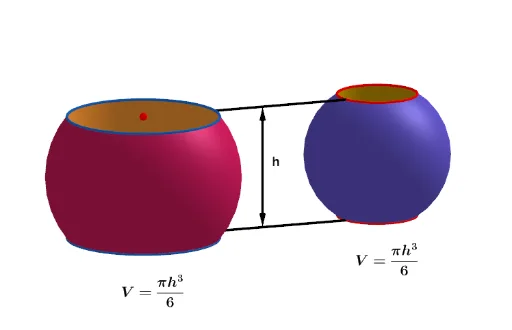
This example demonstrates the Napkin Ring Problem, illustrating that the surface area of a torus formed by rotating a ring is equal to that of a sphere with the same radius. It involves core mathematical concepts such as cylinder, sphere, intersection, fractions, circumcircle, difference and slope, and rotation. The construction uses commands like Sphere, Line, Segment, Point, Mirror, IntersectPath, Intersect, CircleArc, Surface, Distance, Cylinder, Midpoint, PointIn, and Vector, highlighting geometric construction techniques. Suitable for high school solid geometry education, it helps students understand rotational solids and surface area calculations.
GeoGebra Commands & Parameters
Sphere(A, R1) → aSphere(B, R2) → bLine(A, zAxis) → fLine(B, zAxis) → gSegment(C, A) → h1Segment(A, D) → iSegment(E, B) → jSegment(B, F) → kPoint(h1) → GMirror(G, A) → HIntersectPath(p, a) → cIntersectPath(q, a) → dIntersectPath(p, b) → eIntersectPath(q, b) → rLine(G, xAxis) → lLine(H, xAxis) → mIntersect(l, c) → I, JIntersect(m, d) → K, LCircleArc(A, K, I) → sIntersect(l, b) → M, NIntersect(m, r) → O, PCircleArc(B, O, N) → tSurface(s, (2 * π), f) → nSurface(t, (2 * π), g) → oDistance(G, H) → hCylinder(d, h) → u, c_1, vCylinder(r, h) → w, d_1, a_1Midpoint(M, N) → QMidpoint(G, Q) → RMidpoint(P, O) → SMidpoint(H, S) → TMidpoint(R, T) → USegment(I, M) → f_1PointIn(v) → VSegment(V, P) → g_1Vector(U, R) → u_1Vector(U, T) → v_1